Skip to content


Automotive social media marketing turns local attention into test drives, service bookings, and repeat customers. This guide shows dealership owners and auto shop managers how to choose channels, plan content, follow ad rules, and measure sales with a small team and a modest budget.
What is automotive social media marketing?
Automotive social media marketing is the use of social platforms to sell vehicles, parts, and auto services. It combines organic posts, paid ads, and customer conversations to move buyers from first interest to a sale or service booking.
The goal changes with the business. A carmaker builds national demand. A local garage needs calls, booked bays, and a stronger reputation within a short drive of its door.
Automotive social marketing also differs from most retail social work. The purchase costs more, the buying cycle runs longer, and offers carry legal rules. Content must earn trust over weeks, then give a ready buyer a simple next step.
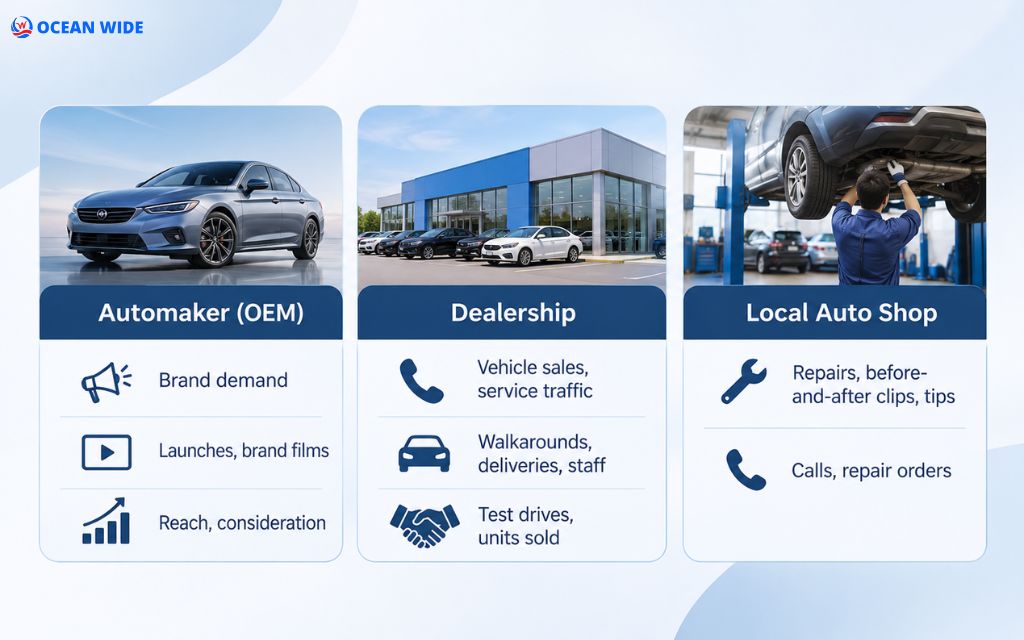
| Business | Main goal | Core content | Main KPI |
| Automaker (OEM) | Brand demand | Launches, brand films | Reach, consideration |
| Dealership | Vehicle sales, service traffic | Walkarounds, deliveries, staff | Test drives, units sold |
| Local auto shop | Booked jobs | Repairs, before-and-after clips, tips | Calls, repair orders |
Why social media matters in the automotive industry
Social media matters because car buyers research for hours before they visit a lot. In Cox Automotive’s 2025 study of 2,344 buyers, we found the average buyer spent 7 hours 11 minutes researching online and used 4.6 sites.
The same study keeps the channel in perspective. Social media reached 26% of those buyers, behind third-party sites at 75%, dealer sites at 59%, and search engines at 41%.
Some marketing blogs claim 90% of buyers consult social media. We could not match that figure to the US buyer data we reviewed, so we plan around 26%. One buyer in four remains a valuable local audience, and social also reaches drivers before they start shopping.
Social media starts the relationship. Your website, listings, and reviews carry the buyer to the showroom.
Social media for the automotive industry also serves current owners. Service reminders, recall notices, and owner events keep your name visible between purchases, a period no buyer survey fully captures.

How your strategy changes by automotive business type
Your strategy should follow how your business earns revenue. Dealers, garages, detailers, and parts sellers each need a different content mix.
Independent and franchise dealerships
Dealerships sell from live inventory, so content should change as stock changes. Post walkarounds, delivery moments, and staff introductions.
Franchise dealers also receive brand and regional content from automakers. Reputation describes 3 tiers: national, regional, and dealership. The dealership tier carries your local proof, such as your team, events, and inventory.
Auto repair, tire, and body shops
Repair shops sell trust before a need arises. A driver rarely plans a brake job, yet that driver remembers the shop that explained brake wear in a 30-second clip.
Post diagnostic tips, finished repairs, and seasonal reminders. Run local ads inside a 10-mile (16 km) radius, and widen it if reach runs thin.

Detailing and specialty shops
Detailers and tint, wrap, and audio installers sell a visible result. Before-and-after video shows that result in seconds, which suits Reels, Shorts, and TikTok.
Show the process as well. Paint correction, ceramic coating, and window tinting all look skilled on camera, and process clips answer common price objections.
Parts and aftermarket brands
Parts sellers win on fitment and proof. Install guides, compatibility answers, and creator reviews reduce buyer doubt.
YouTube suits this work, because a full install can run 10 minutes or longer and keeps answering questions for months. Link each video to the matching product page.

How to build an automotive social media marketing strategy
To build an automotive social media marketing strategy, follow 6 steps in order. These steps give small teams effective social media strategies for car dealerships and service shops, even without a marketing department.
An automotive social media strategy also belongs inside wider marketing strategies for the automotive industry. It should work alongside your website, search listings, email, and sales process.
Step 1: Set goals tied to sales or repair orders
Start with a business number, then pick the content. A dealer might aim for 20 test drives a month from social, and a repair shop might aim for 15 booked brake jobs.
Write 1 primary goal per quarter. Every post and ad then has a clear purpose.
Step 2: Audit your accounts and local competitors
Review 90 days of posts, ads, comments, and messages. List 3 local competitors and note their formats, posting rhythm, and unanswered comments.
Fix the basics first. Your profile name, hours, phone number, and website link should match your Google Business Profile.

Step 3: Map your audience to the buyer journey
Define 3 groups: in-market shoppers, current owners, and local enthusiasts. Shoppers want price, availability, and proof. Owners want service reminders. Enthusiasts want builds, stories, and events.
Our social media funnel guide explains how to give each group a next step.
Step 4: Pick one or two primary channels
Choose channels your customers use and your team can sustain. We recommend Facebook plus one video channel for most local businesses.
Add a third channel after the first two run on schedule for 90 days. A narrow plan done well beats 5 neglected accounts.

Step 5: Build a calendar you can actually keep
Consistency comes from a repeatable workflow. Reserve a 1-hour shoot each week and record 4 to 6 vertical clips. Assign 1 person to film, 1 to edit and schedule, and 1 to answer messages.
Guides we reviewed recommend anything from 3 posts a week to 2 posts a day, and none cites research for its number. Start at 3 posts a week, then raise output when quality holds.
Staff buy-in matters too. Client reviews of automotive agencies mention early friction in getting dealership teams involved, so agree on shoot times with your sales and service managers.
Step 6: Review monthly and reallocate
Compare results against your quarterly goal once a month. Keep formats that drive calls or leads, retire formats that earn only likes, and move budget toward the vehicles or services with the strongest demand.

Which social media platforms work best for automotive businesses?
YouTube and Facebook give automotive businesses the broadest US reach. Pew Research Center’s 2025 survey of 5,022 US adults found 84% use YouTube, 71% use Facebook, 50% use Instagram, and 37% use TikTok.
| Platform | US adults | Best role | Strong formats |
| YouTube | 84% | Research and education | Reviews, walkarounds, how-to videos |
| 71% | Local reach, community, and ads | Inventory posts, events, lead ads | |
| 50% | Visual trust | Reels, Stories, carousels | |
| TikTok | 37% | Discovery | Short clips, shop tips, creator content |
| Not cited | Fleet and B2B sales, recruiting | Company news, fleet offers |
Age changes the mix. Pew reports 80% of adults ages 18 to 29 use Instagram, and 80% of adults ages 30 to 49 use Facebook. A family repair shop can stay close to Facebook, while a tuning or detailing brand may gain more from Instagram and TikTok.
TikTok deserves a test, with one caveat. An Escalent study run in partnership with TikTok found 80% of shoppers who used TikTok during vehicle buying used it for research. That figure describes TikTok users, so it says little about the whole market.

Automotive social media content ideas by buyer stage
Automotive social media content works when each post answers the question a buyer holds at that stage. Use this grid to plan 4 weeks of posts:
| Stage | Buyer question | Content ideas |
| Awareness | Who are you? | Staff intros, shop tours, community events |
| Consideration | Can I trust you? | Walkarounds, trim comparisons, customer stories, repair explainers |
| Decision | Why buy now? | Available inventory, service specials, trade-in steps, test drive booking |
| Ownership | Why come back? | Maintenance tips, recall reminders, owner events |
Local detail makes content harder to copy. A Denver dealer can film tread checks before the first snow, and a detailer can show how to clean road de-icer from a wheel well.
Season matters as much as location. As Reputation notes, few drivers shop for a snow-plow truck at 95°F (35°C). Close each post with 1 clear action: call, message, or book.

Paid social for automotive: where to spend first
Spend first on nearby people who already showed interest. This audience includes website visitors, video viewers, and past customers.
Organic vs. paid: what each one does
Organic posts build trust with people who know you. Paid ads reach new people on a set schedule and budget.
Most local businesses need both. Start by promoting organic posts that already earned comments or calls, because those posts have passed a free test.
Keep the first test small. Set a fixed monthly budget, run 1 offer for 30 days, and compare cost per lead before you scale.
Inventory ads and vehicle catalogs
Meta’s automotive ads promote vehicles from a catalog, a data file with one listing per vehicle. You can connect a feed or upload a CSV, TSV, or XML file. Vehicle sets then group stock by filters, such as model year.
Feed accuracy matters. Remove sold units fast, because an ad for a sold vehicle wastes money and can create legal risk.

Lead forms, retargeting, and fast follow-up
Lead forms let shoppers send contact details without leaving the app. Speed then decides their value, so route each form into your CRM and call within the hour. Our CRM with social media integration guide compares options.
Retarget site visitors with the models they viewed, and exclude people who already bought or booked. Our digital advertising service covers this campaign work for Colorado businesses.
Automotive social media management: reviews, DMs, and comments
Automotive social media management means owning every public and private conversation on your channels. A buyer asking about a truck in a DM is a live lead, so treat the inbox like a phone line.
Set a response target, such as 1 business hour, and name 1 owner per shift. To handle a complaint, follow these 4 steps:
- Acknowledge the problem in public, with a calm reply.
- Move the details to a phone call or private message.
- Resolve the issue and record the outcome.
- Return to the thread with a short update, if the customer agrees.
Hide spam, threats, and abuse. Leave honest criticism visible, because a measured reply shows future customers how you solve problems.
Ask every customer for a review, including the ones who seemed unhappy. An honest mix of reviews reads as more credible than a wall of perfect scores.

Compliance checklist before you post
Automotive ads carry rules that most social media guides skip. Check 3 areas before you publish: pricing, endorsements, and consent.
One rule has changed. A federal appeals court vacated the FTC’s CARS Rule in January 2025 on procedural grounds, before it took effect. Legal analysts still expect FTC and state scrutiny of dealer advertising.
Pricing and vehicle ads
State rules set the details. Colorado’s dealer regulations offer a useful example for licensed dealers:
- Identify a specific vehicle advertised with a price or terms by year, make, model, and stock number or full VIN.
- Include costs due at delivery in the price, apart from exceptions such as sales tax and government fees.
- Place qualifying statements beside the offer in clear, readable text.
- Disclose known salvage, rebuilt, or flood history.
Financing offers need one more check. Meta’s special ad categories restrict age, gender, and location targeting, and credit offers such as auto loans can require a 15-mile (24 km) minimum radius. Confirm your category in Ads Manager before launch.

Reviews, testimonials, creators, and employees
The FTC expects clear disclosure when payment, a free product, or employment could affect how viewers judge an endorsement. Put that disclosure in the post or video itself, because a comment or profile bio often falls short. Platform tags alone may not be enough.
Salespeople who praise their employer’s vehicles should disclose that link too. The FTC’s review rule, 16 CFR Part 465, bans fake reviews and fake follower counts, with penalties of $53,088 per violation as of April 2026. Get written permission before you post customer photos.
Lead forms, texts, and contests
Marketing texts often need prior express written consent under the TCPA, and the dealer carries the burden of proof. Fisher Phillips warns dealers against assuming a vendor’s form language is enough.
Review each form, keep consent records, and honor every opt-out across your systems. Contests need a separate check: Colorado dealer rules require a no-purchase-necessary statement in contest ads.

Social trends in the automotive industry worth acting on
Social trends in the automotive industry matter when they fit your budget and staff. We sort them into 3 actions: do now, test, or skip for now.
| Trend | Action | Reason |
| Short-form video | Do now | Phone-shot clips cost little and suit Reels, Shorts, and TikTok. |
| Staff on camera | Do now | Familiar faces build trust before the first visit. |
| AI search visibility | Do now | Cox found 19% of buyers used AI. Clear FAQs and consistent business details can help. |
| Local creators | Test | One well-matched creator tests the format at low risk. Disclose every deal. |
| AI-drafted captions | Test | Drafts arrive faster, but a person must check prices and specs. |
| AR and VR showrooms | Skip for now | Build costs suit automakers more than single-location shops. |
| Branded games | Skip for now | Local buyers need proof and availability first. |
EV content depends on your market. The Colorado Automobile Dealers Association reported in 2025 that EV adoption ran strongest along the urban Front Range. Dealers there can answer charging questions and show real winter range in miles (kilometers).

How to measure automotive social media ROI
To measure automotive social media ROI, connect each post and ad to a business outcome. Engagement shows early interest, and sales and repair orders show the return.
| Funnel stage | Dealership metric | Auto shop metric |
| Attention | Reach, video views | Reach, video views |
| Interest | Vehicle detail page (VDP) views | Service page visits |
| Lead | Forms, calls, DMs | Calls, quote requests |
| Action | Test drives, appointments | Booked jobs |
| Revenue | Vehicles sold, gross profit | Repair orders (ROs), ticket value |
Use 3 tools to connect the data:
- UTM links show social traffic and conversions in Google Analytics.
- Call tracking numbers tie phone leads to each campaign.
- CRM source fields record where each buyer came from.
Calculate simple ROI with this formula: (attributed gross profit − total social cost) ÷ total social cost. For example, $6,000 in gross profit from $2,000 in cost gives a 200% ROI.
Social often assists a sale that another channel closes. Ask every buyer how they found you, because one question at the desk fills gaps that software misses.

Who should run it: in-house, freelancer, or agency?
The right owner depends on your time, skill gaps, and budget. Each option suits a different stage:
| Option | Fits | Trade-off |
| In-house | Shops with a staff member who enjoys filming | Easy lot access, narrower skills |
| Freelancer | Owners who need editing or ad help | Flexible, depends on 1 person |
| Agency | Businesses that want strategy, content, ads, and reporting together | Higher cost, needs on-site coordination |
Keep social in-house when someone already films well and has about 5 hours a week. Hire help when posting stops during busy months or ads run without tracking.
Our cost of social media marketing guide breaks down fees. Small-business management typically runs $500 to $5,000 a month, and ad spend sits outside that fee.

The Ocean Wide Social Marketing Service for auto businesses
The Ocean Wide Social Marketing Service gives local businesses one team for strategy, content, ads, and reporting. We are a Denver-based digital agency founded in 2019, and our work centers on small and local businesses across Colorado.
Auto businesses need what those local brands need: neighborhood trust, steady content, and leads that reach a person fast. We would build your automotive social media marketing program around the steps in this guide, with your ad rules checked in the calendar.
Our social marketing plan lists at $999 per month as of November 2026 and includes:
- A marketing plan on a quarterly, 6-month, or 12-month term.
- 5 posts per week across your active channels.
- Profile optimization for Facebook, Instagram, X, and LinkedIn.
- 1 promoted post per month with $75 in ad spend.
- A monthly report on results.
Our team also handles photography, videography, and drone video in-house. See current plans for up-to-date details.

FAQs about automotive social media marketing
What is the best social media platform for car dealerships?
Facebook is the safest starting point for most car dealerships. It pairs broad US reach with local ads. Add YouTube or Instagram for video.
How often should a car dealership post on social media?
Start with 3 posts a week. Raise output when your team can keep quality and reply to messages on time.
How much does automotive social media marketing cost?
Small businesses typically pay $500 to $5,000 a month for management, plus ad spend. Your market, channels, and video needs change the price.
How long does it take to see results?
Expect early engagement within weeks and steadier leads after 3 to 6 months. This range reflects agency estimates, so results vary by market and offer.
Should a small dealership or auto shop use TikTok?
Yes, if someone can film short clips each week. Test TikTok for 90 days and track calls, messages, and bookings.
Can a dealership post vehicle prices on social media?
Yes, if the post follows your state’s advertising rules. Check vehicle identifiers, included fees, and qualifying statements first.
Does automotive social media marketing work for a single-location shop?
Yes, when you target a tight local area and follow up fast. Reviews, local video, and quick replies build credibility with nearby drivers.