Skip to content


Authentic marketing means your claims match what customers get, and you can prove it. This guide helps small business owners test their promises, show real proof, and follow FTC review rules, so more buyers believe what they read.
What is authentic marketing?
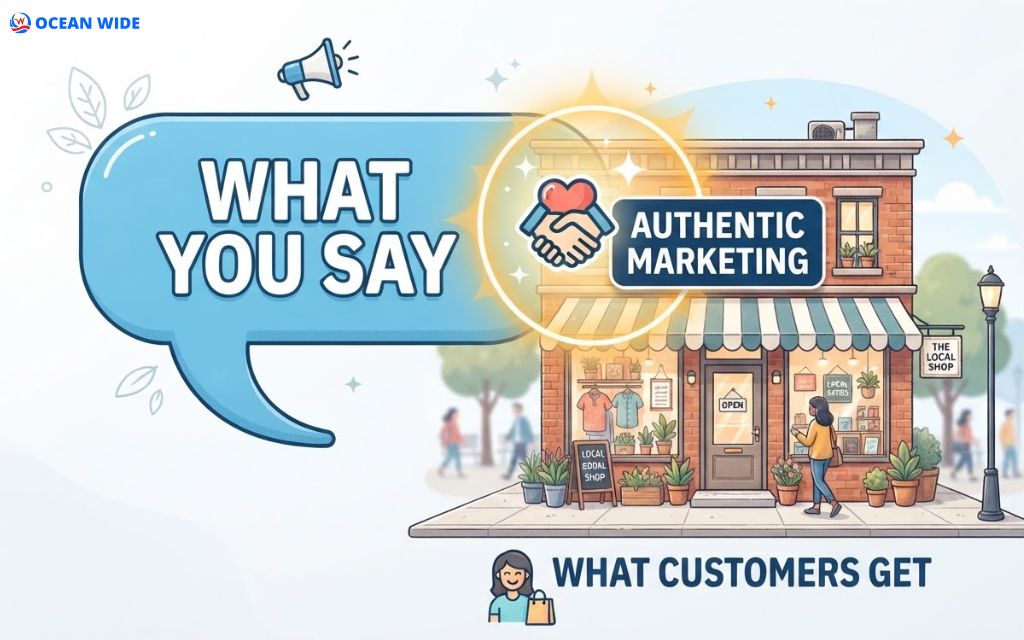
Authentic marketing is marketing whose claims match what customers experience and can verify. It works as a business practice, not a tone of voice. Your ads, website, reviews, and service tell one true story.
Definitions vary across the industry. Bazaarvoice ties the term to causes, EPIC Creative ties it to consistency, and coach George Kao calls it “not pretending.” We use Kao’s test because any owner can run it today: does your marketing match what a typical buyer experiences?
We write this for the businesses we serve, such as restaurants, landscaping companies, and home care providers. Their brand trust rests on plain details: price, timing, workmanship, and who shows up.
What authentic marketing is not
Three myths push small businesses in the wrong direction:
- Cause marketing only: Public stands stay optional. In The 2023 Sprout Social Index, only a quarter of consumers said brands must speak out on causes to be memorable.
- Total disclosure: Honest marketing keeps private matters private. It shares every fact a buyer needs to decide.
- Low production quality: A sharp photo of your real crew is honest. A polished stock photo posing as your crew misleads.
Authentic marketing vs. traditional advertising
Authentic marketing and traditional advertising differ in where the message starts, not in budget. Any ad can pass this comparison when the facts behind it hold up.
| Factor | Claim-first advertising | Authentic marketing |
| Starting point | What the brand wants to say | What is true for customers |
| Evidence | Slogans and superlatives | Reviews, photos, and process details |
| Language | Industry jargon | Words customers use |
| Mistakes | Silence or spin | Public fixes |
Why authentic marketing matters for small businesses
Authentic marketing matters because small businesses win on trust, and buyers now check claims before they call. Three shifts raise the stakes.
Customers check your claims before they call
Buyers compare your promises with public evidence. In BrightLocal’s 2026 Local Consumer Review Survey, we found that 97% of consumers read reviews for local businesses.
Your homepage now competes with your Google Business Profile, Facebook page, and latest review. A claim your reviews contradict can cost you the call.
Trust has to be shown, not declared
Buyers reward brands that earn belief. In Salsify’s 2026 Consumer Research report, we found that 68% of shoppers say they will pay more for brands they trust. Those are survey answers, not measured purchases, yet they point in a clear direction.
Edelman’s 2026 brand trust report, based on 17,688 respondents in 15 countries, reaches the same conclusion:

AI makes generic marketing easier to ignore
Generative tools make polished copy cheap, so polish alone signals little. In our view, specific facts now carry the signal: your crew, your job sites, and your customers’ words.
The claim, proof, experience test
The claim, proof, experience test checks one marketing promise in 3 steps. It is our working method, not an industry standard. It grew from one idea that runs through the guides we reviewed: show the evidence behind the promise.
- Write the claim: Copy the exact promise from your website, ad, or sales script.
- Name the proof: List evidence a stranger could check, such as job records, reviews, or photos.
- Check the experience: Compare the claim with what a typical customer receives, not your best case.
These 3 sample audits show the test in use:
| Claim | Proof | Experience check |
| “Same-day repairs” | 90 days of job records | Share of jobs finished the same day |
| “Transparent pricing” | Published price ranges | Final invoices compared with quotes |
| “Family-owned since 2010” | Owner photos and story | Whether customers meet the family |
Rewrite or remove the claim, if any column stays empty. This single habit catches more problems than a new slogan will.

How to make your marketing more authentic
To make your marketing more authentic, follow these 7 steps in order. Each step produces something you can review with your team this month.
1. Start with your customers’ own words
Pull language from reviews, call notes, emails, and social comments. Silverback Strategies suggests open-ended prompts, such as what a customer would tell a friend who asked about you. Reuse the phrases that repeat.
2. Define what you stand for and what you don’t
Write a one-page brand style guide that covers voice, values, visuals, and claims you won’t make. Agency leaders on the Forbes Agency Council recommend building this guide early, because it keeps staff, freelancers, and partners on one story. Our branding and website design work is a natural place to start.

3. Make your claims specific and provable
Replace superlatives with facts. “Best landscapers in town” gives a buyer nothing to check. “We edge every bed and lay 3 inches (7.6 cm) of mulch” gives them a standard you can meet.
4. Show real people and real work
Photograph your team, job sites, and finished work. Authentic does not mean amateur: Toast TV notes that high production values are not the problem, while untrue stories, casting, or claims are. Our photography and videography team can capture real work at a professional standard.

5. Let customers speak, and follow the rules
Ask every customer for feedback, not only the happy ones. Get permission before you reuse a photo, review, or testimonial. The FTC section below explains where the legal lines sit.
6. Stay consistent across every touchpoint
Match your name, offers, prices, and tone across your website, Google Business Profile, social profiles, and printed materials. Consistency creates familiarity, and EPIC Creative links familiarity to trust because customers know what to expect.

7. Own your mistakes in public
Answer negative reviews with facts, an apology when you owe one, and a fix. Bazaarvoice describes how French retailer Castorama redesigned a problem shower kit and sent new kits to customers who had complained.
Authentic marketing examples you can learn from
Authentic marketing examples range from national campaigns to one-line website edits. The scale changes, but the principle holds: the business backs each message with action.
What it looks like at a national scale
Patagonia ran a “Don’t Buy This Jacket” ad in The New York Times on Black Friday, November 25, 2011. The company paired the message with its Common Threads Initiative, which covered repair, reuse, and recycling. We leave out sales figures because we could not trace the numbers often repeated online to a primary source.
What it looks like for a local business
Local businesses gain more from precise wording than from big gestures. These 3 hypothetical rewrites show the shift:
| Business | Generic claim | Authentic version |
| Restaurant | “Best tacos in town” | “We press our corn tortillas by hand every morning.” |
| Landscaping | “Quality lawn care” | “The same 2-person crew visits weekly within our 25-mile (40 km) service area.” |
| Home care | “We treat you like family” | “You meet your caregiver before the first visit.” |
Use a version like these only when your operations deliver it every time.

Authentic reviews and the FTC rules behind them
The Federal Trade Commission’s Consumer Review Rule bans fake reviews and several related tactics in the US. These 5 practices create the clearest risk for a small business:
- Posting fake reviews: The rule covers reviews from people who don’t exist, including AI-generated ones, and people without real experience of the business.
- Paying for sentiment: Businesses can’t offer rewards on the condition that a review is positive or negative.
- Hiding insider ties: Testimonials from officers, managers, and employees need a clear disclosure of the connection.
- Suppressing criticism: Groundless legal threats and intimidation can’t be used to remove negative reviews.
- Buying fake influence: The rule bars buying bot-generated followers or views for commercial gain, when the buyer knows or should know they’re fake.
The maximum civil penalty stands at $53,088 per violation as of November 2026, and the FTC sent warning letters to 10 companies in December 2025. This section offers general information, not legal advice.

Authentic content in the age of AI
Authentic content now faces 2 tests: whether AI-assisted work stays honest, and whether readers can verify where content came from. The first test concerns how you create marketing. The second concerns proof of origin.
Can AI-assisted content still be authentic?
Yes, AI-assisted content can be authentic when a person checks it, adds real experience, and takes responsibility for it. Google says it rewards high-quality content however it is produced. It treats automation used mainly to manipulate rankings as a spam policy violation.
Audiences are warier than advertisers assume. In the IAB’s 2026 study, we found that 82% of ad executives believed Gen Z and Millennial consumers felt positive about AI-generated ads, while 45% of those consumers did. We recommend using AI for research and first drafts, while people own the facts, stories, and final approval.
Authentic content vs. verified content
Authentic content has 2 meanings. In marketing, it reflects a brand honestly. In records and media, the authenticity of content means you can confirm its source and show that no one altered it.
The U.S. Government Publishing Office defines authentic content as verified complete and unaltered, and official content as approved by or sourced from an official source. So “official and authentic content” describes verified records, not brand voice. C2PA Content Credentials follow the same logic: they record provenance without judging whether the content is true.

5 common authentic marketing mistakes
Five mistakes undo authentic marketing faster than a weak campaign does:
- Chasing trends without a reason: In The 2025 Sprout Social Index, 33% of consumers said brands jumping on viral trends is embarrassing.
- Claiming values without action: Pepsi apologized for a 2017 ad that critics said trivialized Black Lives Matter. Pair every values message with something you do.
- Leaving old claims live: Southwest built its brand on free checked bags, then began charging on May 28, 2025. Review your pages and ads after every policy change.
- Passing stock photos off as staff: Generic images break trust the moment a customer meets your team.
- Filtering reviews: Showing only 5-star reviews while implying they represent all feedback can break the FTC rule.

How to tell if your marketing feels authentic
No single metric measures authenticity, so track these 5 signals each quarter:
- Review language: Customers repeat the promises you make, in their own words.
- Buying reasons: New customers give the same reason for choosing you that your marketing gives.
- Repeat customers: Past buyers return without a discount.
- Referrals: Customers introduce you to friends, neighbors, and colleagues.
- Shares with commentary: People add their own words when they share your content, a sign Jessy Grossman of Women in Influencer Marketing points to.
Ask someone outside your company to read your website and your latest 20 reviews side by side. A fresh reader spots gaps your team has stopped seeing.

When to bring in an agency
Bring in an agency when you have true stories but lack the time or skills to tell them well. Authenticity survives outsourcing when the business supplies the facts and the agency shapes how they appear.
Before you hire anyone, ask 3 questions: who interviews our customers, who approves our claims, and where do our images come from? We hold ourselves to the same standard. Our designers, developers, and strategists work from both the US and Vietnam, and our portfolio shows the work behind that team.

Social Marketing Service from The Ocean Wide
Social media is often where customers first test your claims, so authentic marketing has to hold up there too. Our Social Marketing Service helps small businesses turn real work, real team stories, and real customer moments into consistent social content.
Because our team also covers branding, graphic design, photography, and videography, your posts can feature your own people and projects. No agency can honestly promise a viral post, so ask for a plan built on your real work. Explore our Social marketing options to see how that plan could look for your business.

Frequently asked questions about authentic marketing
What is an example of authentic marketing?
A home care provider that says “you meet your caregiver before the first visit” and does it every time. The promise is specific, and customers can check it.
How do I know if my marketing feels authentic to customers?
Compare your claims with your reviews. Customers should describe the same experience you promise. Run the claim, proof, experience test on your top 5 promises.
Can authentic marketing still be persuasive?
Yes, authentic marketing can persuade when it stays honest about the exchange. You can show benefits and create desire, as long as the claims hold up.
Does authentic marketing mean taking a stand on social issues?
No, authentic marketing does not require a public stand. Speak out only when an issue connects to your values and you can back it with action.
Can high-quality video or photography feel authentic?
Yes, professional production can feel authentic when it shows real people and true claims. Viewers question honesty, not good lighting.
Can authentic marketing include asking customers for reviews?
Yes, authentic marketing can include asking customers for reviews. Ask them all, and never tie a reward to a positive rating. Disclose any connection that could affect credibility.
What is the difference between authentic content and official content?
Authentic content is verified as complete and unaltered, while official content comes from an official source. This is the GPO usage. Marketers use “authentic” more loosely.