Skip to content


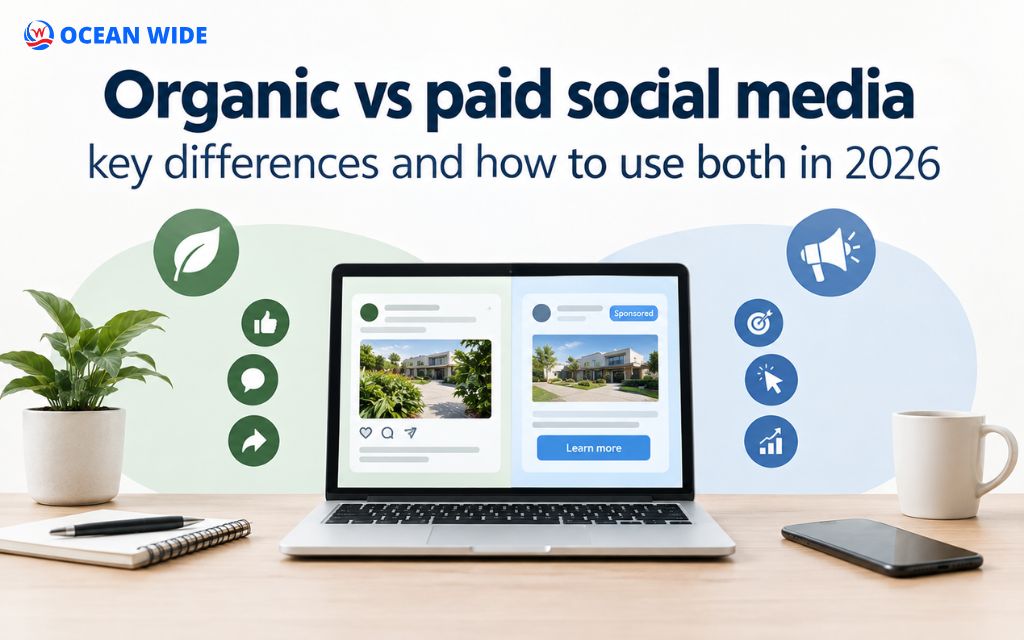
Organic vs paid social media comes down to one trade: you spend time to earn reach, or you spend money to buy it. This guide is for small business owners and in-house marketers deciding where to start. We explain what each approach does, what it costs, and how to mix both so posts turn into calls, bookings, and sales.
Organic vs paid social media: what is the difference?
Organic social media is unpaid content that reaches your followers and anyone the algorithm recommends it to. Paid social media is content you pay a platform to show to a chosen audience.
Organic builds trust over time. Paid buys reach, speed, and targeting. In our work with local businesses, such as restaurants, landscaping companies, and home care providers, the real question is which one to fund first and when to add the other.
Here are the 4 points to remember:
- Organic social builds credibility: A steady feed gives prospects proof that a real, active team runs the business.
- Paid social delivers reach: Ads put your offer in front of new people within days, filtered by location, interests, and behavior.
- Organic reach stays low: Brand pages reach a small share of their own followers, so ads fill the visibility gap.
- A hybrid plan performs best: Most small businesses test messages organically, then pay to amplify the posts that prove themselves.
What is organic social media?
Organic social media is every post, reply, and interaction a business publishes without paying for distribution. It includes feed posts, Reels, Stories, TikTok videos, LinkedIn updates, and YouTube uploads. The platform algorithm decides how far each piece travels.
What counts as organic social activity
Organic social covers 4 types of activity on your business profiles:
- Publishing unboosted content, such as photos, carousels, and short videos, on a regular calendar.
- Answering comments, direct messages, and reviews in public threads and private inboxes.
- Resharing user-generated content (UGC), such as customer photos, tagged posts, and video testimonials.
- Sharing company posts through employee accounts, a tactic marketers call employee advocacy.
Who sees your organic posts
Your organic posts reach 4 groups: a share of your followers, people who visit your profile, friends of anyone who shares the post, and non-followers who get it as a recommendation. Short-form video, such as Instagram Reels, TikTok clips, and YouTube Shorts, tends to reach the most non-followers.

6 benefits of organic social media
The benefits of organic social media center on trust, community, and insight, 3 assets that ad budget alone cannot build. Organic content delivers 6 specific advantages:
- Trust and credibility: People trust content that reads like advice more than content that reads like an ad. A helpful feed shows a real team behind the logo.
- Zero media cost: Posting is free on every major platform. Your investment is time, creative skill, and tools.
- Community and loyalty: Replies, polls, and DMs turn followers into repeat customers. Loyal followers also share posts, which extends reach for free.
- A customer service channel: Customers ask questions and raise issues in comments. Calm, fast replies protect your reputation, as our guide on social media complaints explains.
- Audience insights: Comments, saves, and shares reveal which topics and formats resonate. That data tells you which posts deserve an ad budget later.
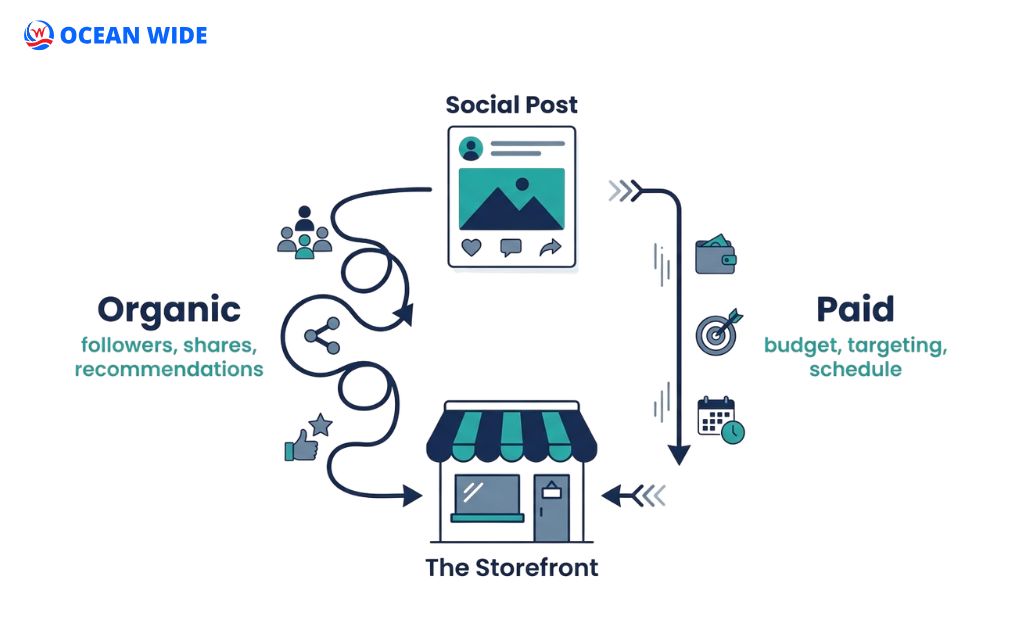
- A storefront for ad clicks: People who see your ad often open your profile before they call. A recent, active feed confirms you are open, real, and responsive.
When we audit a new client’s social accounts, we check the profile before the ads. A last post from 8 months ago weakens every ad dollar that sends people to that page.
Rule of thumb: fix the profile before you fund the first ad. Ads send traffic, and your feed decides whether that traffic trusts you.

4 limits of organic social media
Organic social media has 4 limits that slow results for small businesses:
- Low reach: Socialinsider’s study puts the average organic reach rate at about 3.2% of followers on Instagram and 1.25% on Facebook as of August 2026. A Facebook page with 2,000 followers reaches roughly 25 people per post.
- Slow growth: Audiences grow through months of consistent posting. In our experience, local accounts need 3 to 6 months of steady activity before engagement trends become reliable.
- Algorithm dependence: Platforms change ranking signals without notice. A format that reached thousands last quarter can stall this quarter.
- Hidden production cost: Organic is free to post, not free to produce. Photography, video editing, copywriting, and comment replies take hours every week, even on a 3-post schedule.

What is paid social media?
Paid social media is any content a business pays a platform to distribute to a chosen audience. It includes boosted posts, campaigns built in an ad manager, sponsored content, and paid creator partnerships. You control the budget, the audience, and the schedule.
Boosted posts vs Ads Manager campaigns
A boosted post is an existing post with a budget attached. An Ads Manager campaign is a full ad build with more objectives, formats, and controls. Meta treats both as ads and bills both through your ad account.
| Feature | Boosted post | Ads Manager campaign |
| Setup | Minutes, from the post itself | Campaign, ad set, and ad levels |
| Creative | Uses the existing post | New creative or an existing post, in carousel, video, Stories, and other formats |
| Goals | Short list, such as engagement, messages, and link clicks | Full list, including leads, sales, and app installs |
| Conversion tracking | Limited | Full, with the Meta Pixel or Conversions API |
| A/B testing | Not available | Built in |
| Best use | Amplifying a proven post | Leads, sales, retargeting, and testing |
We use boosts for one job: putting a small budget behind a post that already earns comments and shares. When the goal is calls, booked appointments, or form fills, we build the campaign in Ads Manager. TikTok Spark Ads and LinkedIn boosted posts follow the same logic: they promote an organic post with fewer options than a full campaign.
Paid creator and influencer partnerships
Paid creator partnerships place your offer in front of an audience that already trusts the creator. Local food bloggers, home improvement creators, and neighborhood lifestyle accounts suit small businesses. The Federal Trade Commission (FTC) requires creators to disclose paid relationships, so ask for a clear #ad or paid-partnership label.

Benefits and drawbacks of paid social media
Paid social media trades budget for speed, control, and measurement. It offers 4 benefits:
- Precise targeting: You can reach people within 5 miles (8 km) of your shop, past website visitors, or lookalikes of your customer list.
- Fast delivery: Ads start running after platform review, often within 24 hours, instead of after months of audience building.
- Clear measurement: Cost per click, cost per lead, and return on ad spend (ROAS) tie each dollar to an outcome.
- Flexible scale: You can raise budgets on winning ads and pause losers the same day.
Paid social also carries 4 drawbacks:
- Ongoing cost: Visibility ends when spend ends, and competition raises costs in busy seasons.
- Ad fatigue: Performance drops when the same people see the same ad too often.
- Skill demands: Audiences, creative testing, and conversion tracking take specialist time.
- Policy limits: Meta’s Special Ad Categories restrict ads about employment, housing, financial products and services, and social issues or politics.
Special Ad Categories remove age, gender, and ZIP code targeting, and location targeting needs at least a 15-mile (24 km) radius. A home care agency recruiting caregivers or a lender promoting loans must plan campaigns around these rules.

Paid vs organic social media: side-by-side comparison
Organic social wins on trust and longevity, and paid social wins on speed and control. The 9 criteria below show where each approach leads:
| Criteria | Organic social | Paid social |
| Main goal | Trust, community, and brand recall | Reach, leads, and sales |
| Cost | Time, content production, and tools | Ad spend plus management and creative |
| Reach | A share of followers plus recommendations | Set by budget and targeting |
| Targeting | Followers and algorithm picks | Location, demographics, interests, and custom audiences |
| Speed | Builds over months | Starts within days |
| Longevity | Posts keep working on your profile | Visibility stops when spend stops |
| Control | Full creative freedom, no control over distribution | Control over audience, timing, and frequency; ad policies apply |
| Skills | Content creation, copywriting, and community management | Targeting, testing, tracking, and analytics |
| Measurement | Engagement rate, saves, shares, and follower growth | CTR, CPC, cost per lead, and ROAS |
The two approaches cover each other’s gaps. Organic gives paid ads a credible destination, and paid gives organic content an audience it cannot reach alone.

Organic and paid social vs organic and paid search
Organic vs paid advertising applies to search as well as social, but the 2 channels reach people at different moments. Social media creates demand by showing content to people who were not looking. Search captures demand from people typing a need into Google.
A landscaper who posts spring cleanup videos on Instagram sparks interest. The same landscaper ranking for “spring cleanup near me” or running Google Ads catches buyers ready to book. Most local businesses need both; we cover the search side through our SEO service.

Which should a small business start with?
Start with organic social if your profile is new or your budget is tight, and add paid social once you have a clear offer, an active profile, and a test budget. Your goal, timeline, and team capacity decide the mix.
Start organic-first when
Your profiles are new or inactive, because ads that lead to an empty feed waste clicks.
Your messages are untested, because free posts show which offers and formats resonate.
Your budget covers content but not media, because consistent posting still builds a base.
Add paid social when
You have a time-sensitive offer, such as a grand opening, a seasonal service, or a holiday menu.
You need leads this month, not next quarter.
You expand into a new service area where few people know your name.
Your organic posts prove a message, giving you a tested creative to scale.
3 local business scenarios
Team capacity matters as much as budget. Organic social needs someone who can shoot, write, and reply every week. Paid social needs someone who can read data, adjust audiences, and pause weak ads. If one owner covers both, start with the channel that matches the skills you already have.
Each local business type below uses organic and paid social for a different job:
- A new neighborhood restaurant: Post daily specials and kitchen videos organically. Pay to reach people within 3 miles (5 km) during the opening month.
- A landscaping company before spring: Share before-and-after projects all year. Run lead ads in February and March aimed at homeowners in your service ZIP codes.
- A home care agency hiring caregivers: Share caregiver stories organically. Plan recruitment ads within Special Ad Categories rules and their 15-mile (24 km) minimum radius.

How to combine organic and paid social in 6 steps
To combine organic and paid social, test messages for free and pay to scale the winners. We run this 6-step loop for clients:
1. Set one goal per channel: Assign organic to trust and engagement, and assign paid to leads or sales.
2. Test content organically: Post 3 to 4 variations of a message over 2 weeks, using a simple marketing experiment setup.
3. Boost proven winners: Put a small budget behind posts that beat your average engagement rate.
4. Rebuild winners in Ads Manager: Turn the top post into a lead or sales campaign with a clear call to action.
5. Retarget warm audiences: Show offers to people who engaged with posts, watched videos, or visited your website.
6. Review and refresh creative: Check paid campaigns weekly and organic trends monthly, and swap ads when frequency rises and click-through rate falls.
A boosted post that already earned comments starts with social proof. A brand-new ad starts from zero.

Metrics to track for organic and paid social
Track engagement metrics for organic social and cost metrics for paid social, then connect both to leads. A shared report, such as the one in our guide on how to build a social media dashboard, keeps both in one view.
| Goal | Organic metrics | Paid metrics |
| Awareness | Reach, impressions, and follower growth | Reach, CPM, and frequency |
| Engagement | Engagement rate, saves, shares, and comments | Ad engagement rate and CTR |
| Traffic | Profile visits and link clicks | CPC and landing page views |
| Leads and sales | DMs, calls, and form fills from tagged links | Cost per lead, conversion rate, and ROAS |
CPM is the cost per 1,000 impressions, CTR is the share of viewers who click, and ROAS is revenue divided by ad spend. Add UTM parameters to every link, track them in Google Analytics 4 (GA4), and use a call tracking number to see which posts and ads produce calls.
In client reports, we place organic and paid results on the same page. That view shows when an organic post lifts ad performance, and it stops teams from judging each channel in isolation.

5 common mistakes when mixing organic and paid social
Small businesses lose budget and momentum through 5 recurring mistakes:
- Boosting every post: Budget spreads thin when untested posts get the same money as proven ones.
- Judging success by likes: Likes rarely pay bills, so measure calls, bookings, and cost per lead.
- Running ads in a different voice from your feed: Mismatched tone and visuals make the brand feel inconsistent.
- Pausing organic posts once ads start: Ad clicks land on a stale profile and lose trust.
- Skipping ad policy checks: Hiring, housing, and finance ads face targeting limits and rejections.

The Ocean Wide Social Marketing Service: organic and paid social in one plan
Our Social Marketing Service treats organic vs paid social media as one plan, not a choice. Organic content builds trust on your profiles, and paid campaigns scale the posts that prove themselves. We are a Denver-based team that works with small and local businesses, such as restaurants, landscaping companies, and care providers.
The service covers 5 areas of work:
- Strategy: audience research, competitor analysis, content pillars, and a KPI roadmap.
- Content creation: short-form video, graphics, and carousels built for each platform.
- Social media management: scheduling, comment and DM replies, and community building.
- Paid social advertising: Facebook, Instagram, TikTok, and LinkedIn campaigns, supported by our digital advertising team.
- Analytics and reporting: dashboards that show where the budget goes and what it returns.
We follow 5 phases: discovery, strategy, content and campaign setup, launch and optimization, and reporting. Book a free call to see how our social marketing plan fits your goals.

FAQs about organic vs paid social media
What is organic social media?
Organic social media is unpaid content and interaction a business publishes on its social profiles. It includes posts, Reels, Stories, replies, and shared customer content that reach people without ad spend.
What is the difference between organic and paid social media?
The difference is who pays for distribution. Organic content earns reach through followers, shares, and algorithms, while paid content buys reach through a budget and targeting settings.
What are the benefits of organic social media?
Organic social media builds trust, community, and audience insight at no media cost. It also gives ad clicks a credible profile to land on.
Is paid social better than organic?
Neither is better on its own. Paid social wins on speed and targeting, and organic social wins on trust and longevity, so most businesses use both.
Should I boost a post or use Ads Manager?
Boost a post to amplify proven content; use Ads Manager to generate leads or sales. Ads Manager adds conversion objectives, A/B testing, and detailed targeting.
How long does organic social media take to work?
Organic social usually needs 3 to 6 months of consistent posting to show reliable trends. Paid campaigns can produce measurable results within the first few weeks.
Does organic social media still work in 2026?
Yes, organic social still works for trust, community, and testing, even with low reach. It works best when paid social amplifies the posts that perform.
How much should a small business spend on organic vs paid social media?
Budget time for organic social and a fixed test budget for paid social. Organic needs steady hours for content, replies, and reporting each week. For paid social, run each campaign on a set test budget for 2 to 4 weeks, then scale only the ads that produce leads at a profitable cost per lead. Your margins and customer value set the ceiling.