Skip to content


B2B social media marketing helps small and mid-sized companies stay visible to business buyers long before they request a quote. This guide is for owners and marketers on a team of 1 to 3 people. It covers which platforms to use, a 7-step strategy, paid social, and simple ways to measure results without enterprise software.
What is B2B social media marketing?
B2B social media marketing is the use of social platforms, such as LinkedIn, YouTube, and Facebook, to build awareness, trust, and relationships with business buyers. Its goal is to support lead generation and sales across a long, multi-person buying process.
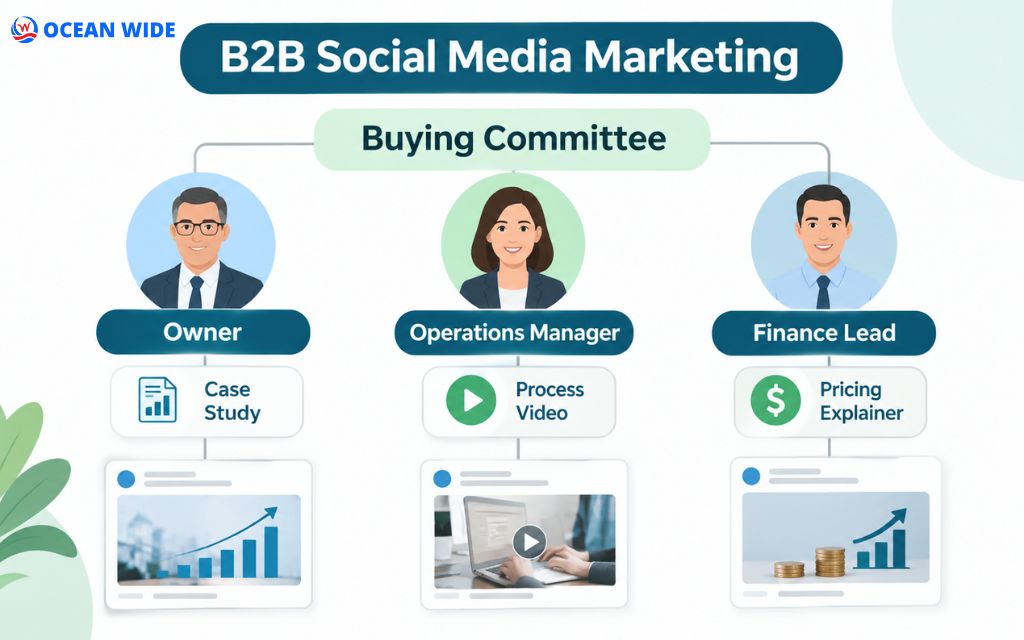
Business-to-business social marketing targets a buying committee, not a single shopper. An office manager finds your post, a finance lead checks your pricing page, and the owner signs the contract. Each person needs a different message.
Social media marketing for B2B companies also includes paid social. Ads, retargeting, and sponsored posts put proven content in front of the exact job titles and industries you sell to.
B2B vs. B2C social media: what changes
B2B and B2C social media differ in 5 areas: the buyer, the sales cycle, the content, the platforms, and the metrics.
| Area | B2B social media | B2C social media |
| Buyer | Several roles, such as owner, operations lead, and finance | 1 person or household |
| Sales cycle | Weeks to months, with contracts and approvals | Minutes to days |
| Content | Expertise, process, proof, and case studies | Lifestyle, offers, and entertainment |
| Main platforms | LinkedIn, YouTube, and industry communities | Instagram, TikTok, and Facebook |
| Key metrics | Qualified leads, sales conversations, and pipeline | Sales, reach, and engagement |
Does social media marketing work for B2B?
Yes, social media works for B2B, but it works as a memory and trust channel, not a fast-sales channel. Professor John Dawes of the Ehrenberg-Bass Institute, in research published with the LinkedIn B2B Institute, found that only about 5% of B2B buyers are in the market at any given time.
The other 95% will buy later. A company that signed a 3-year contract with a supplier last month will not switch this week. Social media keeps your name in front of that 95%, so you make the shortlist when their need returns.
We see the same pattern in our B2B client work. Posts rarely close deals on their own. They build familiarity, so sales calls start warmer and prospects mention content they saw months earlier.
Expert content matters most here. In the 2025 Edelman and LinkedIn B2B Thought Leadership Impact Report, which surveyed 1,934 US business decision-makers, more than half said they use thought leadership content to vet potential vendors.
Social media for B2B has 3 clear strengths and 3 limits:
| Social media can | Social media cannot |
| Keep your brand familiar to future buyers | Replace your sales team or follow-up process |
| Show expertise through how-to and process content | Produce steady leads in the first 30 days |
| Warm up prospects before a sales call | Fix an unclear offer or a weak website |

Which social media platforms work best for B2B?
LinkedIn works best for most B2B companies, followed by YouTube and Facebook, depending on your industry and buyer. Start with 1 or 2 platforms your buyers already use, and expand only after 90 days of consistent posting.
LinkedIn: the default starting point
LinkedIn has more than 1 billion members and lets you reach people by job title, company, and industry. In the Content Marketing Institute’s B2B research, 84% of B2B marketers named LinkedIn the organic platform that delivers the most value. LinkedIn suits thought leadership, hiring posts, case studies, and direct outreach. Document carousels, short native videos, and LinkedIn Newsletters carry longer insights.
Facebook and Instagram: retargeting and visual industries
Facebook and Instagram fit B2B companies that sell to small business owners or work in visual trades, such as commercial landscaping, construction, and signage. These platforms show finished projects well. Meta’s ad tools also offer low-cost retargeting to people who visited your website.

YouTube: demos, how-tos, and proof
YouTube works as a search engine for B2B buyers who want to see a product or process before they call. Short demos, installation walkthroughs, and client interviews keep earning views for years. You can also cut each video into clips for LinkedIn.
X, Reddit, and niche communities
X, Reddit, and industry forums suit B2B companies whose buyers discuss problems in public. IT managers, software teams, and engineers often ask peers for vendor advice in these spaces. Join as a helpful expert, disclose your company, and skip the sales pitch. Communities react badly to disguised promotion, so transparency protects your reputation.
How to choose 1 or 2 platforms
To choose platforms, match each channel to where your buyers research, the content you can produce, and the targeting you need.
| Platform | Best for | Content type | Ad targeting |
| Professional services, B2B services, and manufacturing | Text posts, document carousels, and video | Job title, company size, and industry | |
| Facebook and Instagram | Local B2B suppliers and visual trades | Photos, Reels, and project showcases | Interests, website visitors, and customer lists |
| YouTube | Technical products, equipment, and software | Demos, tutorials, and client stories | Topics, keywords, and remarketing |
| Reddit and forums | Software, IT, and technical buyers | Answers, discussions, and AMAs | Communities and interests |

How to build a B2B social media marketing strategy in 7 steps
To build a B2B social media marketing strategy, connect each social activity to a business goal, then plan content for the people who influence the purchase. The 7 steps below fit a team of 1 to 3 people.
1. Tie social goals to business goals
Start with the revenue goal, then work backward. If you need 10 new commercial accounts this year, social media supports 3 jobs: awareness, website visits, and sales conversations. Set 1 metric for each job, such as profile views, website sessions, and inbound inquiries.
2. Define your ICP and the buying committee
An ideal customer profile (ICP) describes the companies that fit you best: industry, size, location, and budget. Next, list the roles inside those companies. For a commercial cleaning firm, the buying committee may include a facility manager, an office manager, and a CFO.

3. Pick your platforms
Pick 1 primary platform and 1 secondary platform from the table above. A common starting pair is LinkedIn plus YouTube for technical products, or LinkedIn plus Facebook for local B2B services.
4. Build 3 to 4 content pillars
Content pillars are the recurring themes you post about. Use 3 to 4 pillars, such as client problems and fixes, behind-the-scenes process, team expertise, and proof from finished projects. Pillars keep your feed consistent and make planning faster.

5. Decide who posts: company page vs. personal profiles
Your company page holds the official record, but personal profiles reach more people. Third-party studies of LinkedIn feeds show that company page posts reach a small share of followers, while posts from people travel further. Use the company page for announcements, job posts, and ads. Use personal profiles for opinions, lessons, and stories. In a 5-person firm, the owner’s profile often becomes the main channel.
6. Plan a 90-day content calendar
A 90-day calendar gives you enough posts to test topics without burning out. Plan 3 posts per week per platform, which equals about 36 posts per quarter. Batch-produce content in 1 monthly session: shoot photos and video, write captions, and schedule posts in a tool, such as Buffer, Hootsuite, or Meta Business Suite.

7. Engage, don’t just broadcast
Social selling means using social platforms to start and build conversations with prospects. Spend 20 to 30 minutes a day commenting on buyer and partner posts, replying to comments, and connecting with people who engage. A thoughtful comment on a buyer’s post puts your name in front of them without a pitch. Send connection requests with a short note that references their post or company.
B2B social media content that works at each funnel stage
Effective B2B content matches the buyer’s stage: awareness, consideration, or decision. Use the table below to balance your calendar across all 3 stages.
| Stage | Buyer question | Content examples |
| Top of funnel (awareness) | “Do I have this problem?” | Industry tips, common mistakes, and short educational videos |
| Middle of funnel (consideration) | “How do companies solve this?” | Process breakdowns, comparison posts, webinars, and checklists |
| Bottom of funnel (decision) | “Why this vendor?” | Case studies, client testimonials, pricing explainers, and team intros |

Content ideas for B2B service businesses
B2B service businesses already own 5 content sources:
- Before-and-after project photos: A commercial landscaper can show the same property in March and again in July.
- Job-site walkthrough videos: A 60-second clip of a crew preparing a 2,500-square-foot (232 m²) office floor shows process and care.
- Client FAQ answers: Each question from a sales call becomes 1 post that answers it in plain language.
- Team spotlights: A short profile introduces the technician, account manager, or designer the client will meet.
- Downloadable checklists: A 1-page guide works as a LinkedIn document post, sized 8.5 x 11 inches (21.6 x 27.9 cm).
Using AI without sounding generic
AI tools speed up drafts, outlines, and caption variations. Keep a human edit on every post: add a real project detail, a number from your work, or a view your team holds. Generic AI posts blend into the feed, and B2B buyers look for proof of real experience.

B2B social media advertising: when and how to add paid
Add paid social once your organic posts show which topics earn engagement, usually after 60 to 90 days of consistent posting. Paid B2B social media advertising then puts your strongest content in front of more of the right people.
LinkedIn Ads vs. Meta Ads for B2B
LinkedIn Ads target by job title, seniority, company size, and industry, which suits high-value contracts. Clicks cost more on LinkedIn than on Meta. Meta Ads on Facebook and Instagram cost less per click and work well for retargeting and for buyers who own small businesses.
Start with a small test budget and 2 to 3 ad variations. Judge results by cost per qualified lead, not cost per click.
Retargeting website visitors
Retargeting shows ads to people who already visited your website. Install the LinkedIn Insight Tag and the Meta Pixel, then build audiences from service-page and pricing-page visitors. These visitors know your brand, so case studies and consultation offers fit them better than cold introductions.

Boosting your best organic posts
Boosting turns a proven organic post into an ad. Pick posts with above-average comments or saves, then promote them to a matched audience for 1 to 2 weeks. This method lowers creative risk because your audience already tested the message.
How to measure B2B social media ROI without enterprise tools
To measure B2B social media ROI, track 4 levels: attention, engagement, website action, and revenue. Free tools cover each level, so small teams can report results without attribution software.
- UTM parameters: Tags on every shared link show Google Analytics 4 which platform and post sent each visitor.
- GA4 key events: Form submissions, calls, and quote requests marked as key events connect social visits with leads.
- CRM source field: A required “How did you hear about us?” field captures posts and videos that no tracking tool caught.
- Platform analytics: Monthly checks of reach, engagement rate, and follower growth in LinkedIn and Meta dashboards show content trends.
Then calculate ROI with a simple formula: (revenue from social-sourced deals − social costs) ÷ social costs. Include ad spend, tools, and staff or agency time in your costs. For example, if social-sourced deals bring $40,000 in a year and social costs total $12,000, ROI equals 233%.
Self-reported attribution often reveals “dark social” influence, such as a post forwarded in a private message, that analytics tools miss. Ask every new client where they first heard about you

A realistic B2B social media plan for small teams
A small B2B team can run a steady social program in about 4.5 hours per week. The plan below is our recommended starting point for 1 platform plus daily engagement.
| Task | Frequency | Time per week |
| Publish LinkedIn posts | 3 posts per week | 1.5 hours |
| Engage with buyers and partners | 20 minutes per weekday | 1.5 hours |
| Create 1 short video or photo set | Weekly | 1 hour |
| Review analytics and plan content | Monthly, about 2 hours | 30 minutes |
Add a second platform only after 90 days, when your team has a repeatable process. If you cannot protect 4.5 hours, cut to 2 posts per week before you cut engagement time.

6 common B2B social media mistakes to avoid
Most stalled B2B social programs share 6 mistakes:
- Posting only from the company page, which limits reach to a small share of followers.
- Joining 4 or 5 platforms at once and posting on none of them consistently.
- Pitching in every post instead of teaching and showing proof.
- Reporting likes and followers instead of leads and sales conversations.
- Stopping after 60 days, before out-of-market buyers have seen enough to remember you.
- Repeating statistics without a source, such as recycled claims that 80% of B2B leads come from LinkedIn.

How social media supports SEO and AI search visibility
Social media supports search visibility indirectly. Google has said that social shares are not a direct ranking factor, but social activity can raise branded searches and spread your content to people who link to it. Each blog post or case study you share on LinkedIn reaches a second audience, and some readers save or cite it later.
AI search tools, such as ChatGPT, Perplexity, and Google AI Overviews, also draw on public profiles and discussions when they describe a company. Matching company names, service descriptions, and contact details across LinkedIn, Facebook, and your website help them describe you accurately.

Should you handle B2B social in-house or hire an agency?
Handle B2B social in-house if a team member has 5 hours a week, writing skills, and access to project photos. Hire an agency when you need strategy, video production, paid ads, and reporting together, or when posts keep slipping behind client work. A capable agency delivers a written strategy, a content calendar you approve, and a monthly report tied to leads.
Ask 4 questions before you decide:
- Time: Can someone commit 4 to 5 hours every week for 6 months?
- Skills: Does your team write, design, edit video, and run ads?
- Budget: Can you fund ad spend on top of staff time or agency fees?
- Measurement: Who will set up UTM tags, GA4 events, and monthly reports?

The Ocean Wide social marketing service for B2B companies
The Ocean Wide’s Social Marketing Service plans, creates, and manages B2B social media marketing for small and mid-sized businesses. Our Denver-based team combines social strategy, graphic design, photography, videography, and paid advertising in 1 workflow, so your content and ads stay consistent.
For B2B clients, we start with the buying committee and the 1 or 2 platforms that reach it. Then we build content pillars, a 90-day calendar, and a reporting setup with UTM tags and lead tracking. Review our social marketing options and book a free consultation to find the scope that fits your team.

FAQs about B2B social media marketing
Which social media platform is best for B2B marketing?
LinkedIn is the best starting platform for most B2B companies because it targets job titles, industries, and company sizes. Add YouTube for technical products or Facebook for local B2B services.
How often should a B2B company post on LinkedIn?
Post 3 times per week on LinkedIn as a steady baseline for small teams. Consistency matters more than volume, so pick a frequency you can hold for 6 months.
Is LinkedIn advertising worth it for small B2B companies?
LinkedIn advertising pays off when 1 new client is worth several thousand dollars or more. For lower-value services, start with Meta retargeting and boosted organic posts.
How do you measure ROI from B2B social media?
Connect social traffic and leads to closed revenue. Use UTM tags, GA4 key events, and a CRM source field, then compare social-sourced revenue with total social costs.
Should a small B2B company use Facebook or Instagram?
Use Facebook or Instagram if your buyers own small businesses or your work is visual. Commercial contractors, signage companies, and event suppliers show projects well on these platforms
How long does B2B social media marketing take to show results?
Expect engagement within 4 to 8 weeks and pipeline impact within 6 to 12 months. Long sales cycles and the 95-5 rule mean most buyers act months after they first see your content.