Skip to content


Strong sales or growing social media engagement can make a brand look successful, but those numbers do not always show what customers think about it. People may recognize your business without trusting it, or enjoy your content without considering a purchase.
Brand health tracking helps reveal those differences by measuring how awareness, perception, preference, and loyalty change over time. This guide explains the metrics worth monitoring, the research methods behind them, and how to turn the findings into better marketing decisions.
What is brand health tracking?
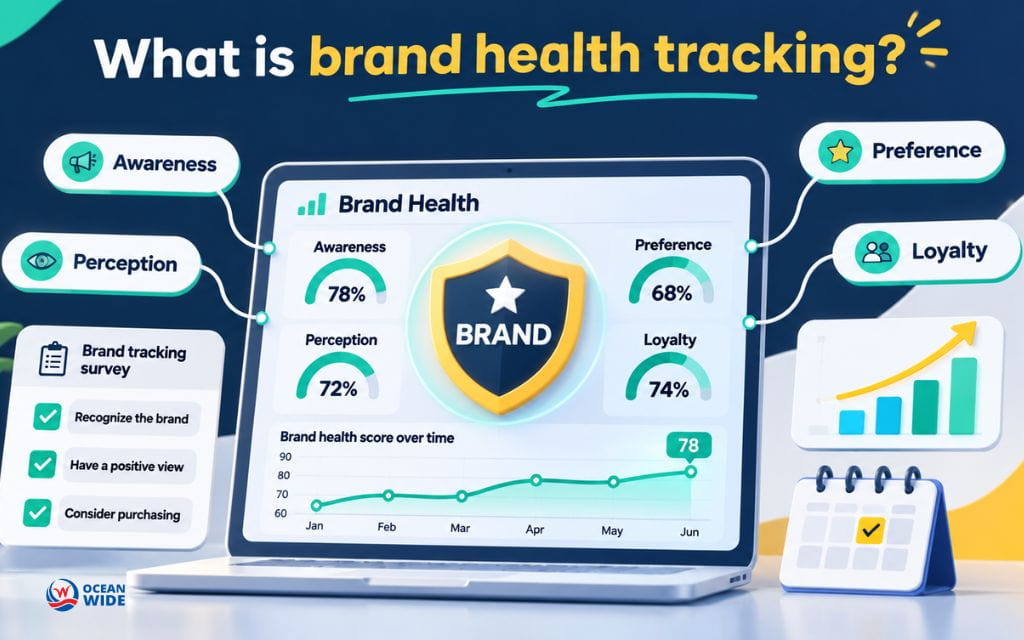
Brand health tracking is the ongoing process of measuring how a target audience knows, perceives, evaluates, and feels about a brand. It typically uses repeated consumer surveys to assess factors such as awareness, consideration, preference, and associations with the brand. Customer feedback, social listening, and behavioral data can provide additional context.
The broader concept of brand health describes a brand’s strength in the minds of its audience and its ability to remain relevant and competitive. One brand health check offers a snapshot at a particular moment. Repeated measurements reveal whether that picture is improving, weakening, or staying relatively stable.
Brand health monitoring is sometimes used interchangeably with brand tracking, but the methods deserve distinction. Social monitoring can alert a business to online conversations today. Well-designed brand health tracking studies evaluate wider consumer perceptions across comparable research periods, including people who have never posted about the brand.
Why is brand health tracking important?
Businesses can lose consideration or trust before a decline becomes obvious in revenue reports. Regular tracking helps marketing teams recognize those shifts and investigate possible causes.
- Detect perception changes early. Falling trust or growing negative associations may signal a problem that deserves attention.
- Understand the customer journey. Comparing awareness, consideration, and preference shows where potential customers lose interest.
- Evaluate competitive position. Tracking the same questions for relevant competitors reveals relative strengths and weaknesses.
- Assess brand-building efforts. Changes across research waves can help evaluate long-term progress, although they do not prove that one campaign caused the change.
- Prioritize improvements. Customer perceptions can guide messaging, product experience, service quality, and content decisions.
What are the key brand health tracking metrics?
No single number can describe overall brand health. The most useful brand health measurement framework combines core consumer-research metrics with supporting customer and digital indicators.
1. Brand awareness and recall
Brand awareness measures whether people know a brand exists. Unaided awareness asks respondents to name brands in a category without showing options, while aided awareness asks whether they recognize a brand when its name is presented.
For example, a survey might ask, “Which meal delivery services come to mind?” before presenting a list of specific providers. Tracking both answers helps show whether a brand is merely familiar or readily recalled when people think about the category.
Calculate awareness as the percentage of eligible survey respondents who recognize or name the brand, using the same question and audience definition in each wave. Social reach and impressions describe media exposure, not population-level brand awareness.

2. Brand consideration and purchase intent
Consideration measures whether consumers would include a brand among their possible choices. Purchase intent asks how likely they are to buy under defined conditions, often using a rating scale.
Both can reveal gaps between recognition and actual interest. When awareness rises but consideration remains flat, investigate perceived value, relevance, pricing, or competitor advantages. Purchase intent reflects a stated likelihood, so it should not be treated as a guaranteed sales forecast.
3. Brand preference
Brand preference shows which option people favor when comparing brands in the same category. Researchers may ask respondents to select their preferred brand or rate each brand against a consistent set of attributes.
Preference helps identify whether positive impressions translate into competitive advantage. Compare results among similar audience segments, since overall preference can hide meaningful differences between first-time buyers and existing customers.

4. Brand perception and sentiment
Brand perception covers the associations consumers make with a business, including quality, reliability, innovation, affordability, or trust. Surveys can ask respondents which attributes they associate with the brand and how strongly they agree with specific statements.
Sentiment analysis offers a different perspective by classifying the tone of public conversations or feedback. Monitoring mentions on social media can uncover recurring praise, complaints, and emerging concerns, including posts that do not tag the company’s account.
Interpret social sentiment carefully. Online conversations are not necessarily representative of the wider market, and automated sentiment tools can misread sarcasm or context. Use these signals to investigate trends rather than substitute them for consumer research.
5. Customer loyalty and advocacy
Loyalty concerns a customer’s willingness to stay with a brand and choose it again. Retention, repeat purchase behavior, and stated repurchase intent can each provide useful evidence, depending on the business model.
Net Promoter Score (NPS) measures willingness to recommend on a 0-to-10 scale. Respondents scoring 9 or 10 are promoters, while those scoring 0 through 6 are detractors. NPS equals the percentage of promoters minus the percentage of detractors. The result can range from -100 to +100.
NPS offers one signal of advocacy, but it does not measure every aspect of loyalty. Use it alongside customer behavior and qualitative feedback.

6. Share of voice and branded search
Share of voice compares how often a brand appears in a defined collection of conversations, coverage, or advertising with competing brands. The calculation depends on the channel and data source, so record exactly what is included.
Branded search trends show whether people are searching for a business or its products by name. Together, these indicators provide context about visibility and demand. They can change because of promotions, seasonality, news coverage, or search behavior rather than shifts in consumer trust.
7. Customer satisfaction
Customer satisfaction captures how customers evaluate a specific experience, product, or interaction. Customer Satisfaction Score (CSAT) commonly uses a survey question with a defined satisfaction scale and reports the share of responses counted as satisfied.
Reviews, complaint themes, support feedback, and service recovery rates add useful detail. Satisfaction is especially helpful for understanding current customers, while brand surveys can also measure attitudes among people who have never purchased.

How to track brand health step by step
Effective tracking starts with a focused research plan. The following process can support a small brand health study or a larger recurring brand tracker program.
1. Define your brand tracking goals
Choose the business questions the research must answer. You may want to know whether a new audience recognizes your brand, why shoppers favor competitors, or whether trust has changed after a product update.
Specify the market, target customers, competitor set, and reporting period before collecting data. Clear goals prevent a brand health tracker from becoming a collection of unrelated charts.
2. Select relevant metrics and benchmarks
Choose a small set of primary indicators aligned with your objectives. Awareness and consideration may matter most for a growing brand, while preference and retention could deserve greater emphasis for an established business.
Record the initial results as your baseline. Your brand health scorecard can show each metric, its definition, the current result, the previous result, and the direction of change. Competitive benchmarks are useful when competitors are measured with equivalent questions and sampling methods.
Some organizations calculate a brand health index by combining several metrics with predetermined weights. Such a brand health score can simplify reporting, but there is no universal formula. Document the weights and preserve the component metrics so the combined number does not conceal a weakness.
3. Conduct consistent brand tracking surveys
Develop a short brand health survey that covers awareness, consideration, preference, and relevant brand associations. Ask neutral questions, keep response options consistent, and avoid revealing the brand being studied before unaided-awareness questions.
Credible brand tracking research also needs an appropriate sample. Include relevant category buyers or potential buyers, not only your email subscribers or social followers. Set clear eligibility criteria and maintain comparable audience composition across waves. If the sample or methodology changes, note the difference before interpreting trends.
For smaller budgets, fewer well-chosen questions administered consistently can be more useful than a long survey that changes every month.
4. Collect insights from multiple data sources
Survey research tells you what people report thinking. Other sources can help explain what they experience and do:
- Social listening: Conversation topics, recurring complaints, and patterns in brand mentions.
- Customer feedback: Reviews, support interactions, interviews, and satisfaction surveys.
- Search and website analytics: Branded search interest, visits, and relevant user behavior.
- Marketing analytics: Campaign reach, engagement, leads, and conversions.
These sources should remain clearly labeled because they represent different audiences and measurement methods. For a closer look at channel performance indicators, see how to measure social media. Social engagement can help explain reactions to content, but it cannot establish whether brand preference improved across the market.
5. Compare results over time and against competitors
Organize findings into a brand health tracker report with consistent time periods, audience segments, and metric definitions. Look at meaningful patterns across multiple survey waves instead of drawing conclusions from one unusually high or low result.
Compare competitors using the same questions and research conditions. Where sample sizes allow, examine important segments such as new versus existing customers. Consider confidence intervals, sample composition, seasonality, and external events before describing a change as significant.
6. Use your findings to improve brand performance
Translate each result into a question worth testing. Low awareness may suggest a need for broader exposure. Strong recognition but weak consideration may call for clearer positioning, stronger proof of value, or a better explanation of product benefits. Falling satisfaction may require an operational response before more promotional activity.
When research points to a messaging problem, a focused campaign supported by a digital advertising service can test whether revised creative reaches and engages the intended audience. Measure campaign outcomes separately from subsequent brand tracking results, and avoid claiming that correlation proves causation.
Assign an owner and a review date to each action. The research becomes more useful when the team can see what changed after its decisions.

How often should you measure brand health?
Tracking frequency depends on your category, pace of change, available sample, and research budget. Monthly tracking can help brands operating in fast-moving categories or during major launches. Quarterly surveys are often a practical starting point for teams that need recurring evidence without collecting data continuously. Less frequent studies may suit brands whose markets change slowly.
Social listening and customer feedback can be monitored more frequently because they help identify immediate issues. Consumer survey waves should follow a consistent schedule with sufficient sample sizes. Frequent surveys are not automatically better if each wave produces unstable estimates.
How to interpret brand health tracking results
Consider a hypothetical company whose unaided awareness increases from 20% to 28%, while consideration decreases from 35% to 30%. Those numbers raise a useful question: Are more people hearing about the brand but finding its offer less relevant or competitive?
Before changing strategy, check whether both survey waves measured comparable audiences, whether the differences exceed expected sampling variation, and whether competitors or market conditions changed. Then review brand associations, customer comments, and purchase barriers for possible explanations.
Present findings in a simple scorecard with the current reading, earlier readings, audience definition, and a note on plausible drivers. Separate observed changes from hypotheses. Where possible, validate suspected causes with additional research or controlled tests.
Common brand health tracking mistakes to avoid
Several measurement mistakes can make brand health research misleading:
- Changing survey questions between waves: Different wording can create an apparent trend where none exists.
- Surveying only existing customers: Loyal customers may have very different views from the broader target market.
- Relying entirely on social sentiment: Public posts reflect a self-selected group of voices.
- Using universal benchmarks without context: Industry, audience, market, and methodology affect what a strong score looks like.
- Tracking too many metrics: An oversized dashboard can distract from the measures tied to business decisions.
- Overinterpreting small changes: Sampling variability and outside events can explain short-term movement.
- Reporting without acting: Insights lose value when no team owns the follow-up.
Make better marketing decisions with The Ocean Wide
Brand health tracking helps businesses understand whether awareness is turning into consideration, whether customers trust what a brand promises, and where its competitive position may be changing. Consistent surveys, supporting behavioral signals, and thoughtful interpretation make those findings more useful than isolated performance numbers.
For businesses ready to connect brand insights with stronger audience communication, The Ocean Wide provides a social marketing service focused on strategy, content, audience engagement, and performance reporting. Contact the team at (720) 334-0899 to discuss how a more informed social media approach can support your marketing goals.
Frequently asked questions (FAQs)
What is the difference between brand health tracking and brand monitoring?
Brand health tracking repeatedly measures broader consumer perceptions through structured research. Brand monitoring usually watches ongoing mentions, feedback, media coverage, or other public signals. The two methods complement each other, but they answer different questions.
How is brand health tracking different from brand lift?
Brand lift studies examine changes in selected brand outcomes associated with exposure to a particular campaign, often by comparing exposed and control groups. Brand health tracking monitors the brand’s broader position over multiple periods, whether or not a campaign is running.
Can small businesses track brand health?
Yes. Small businesses can begin with a focused survey, a few consistently defined metrics, and organized customer feedback. Results from convenience samples should be labeled clearly, since they may not represent everyone in the target market.
How can businesses improve their brand health?
Start with the weakest relevant metric and investigate its cause. Improving brand health may require clearer positioning, consistent messaging, better customer experiences, or stronger product value. Repeat the same measurements to evaluate progress.
What should a brand health tracker report include?
Include the target audience, survey dates, sample details, metric definitions, current and previous results, competitor comparisons where appropriate, and the main actions recommended. Keep the scorecard concise and show limitations alongside trends.
Are there universal benchmarks for a good brand health score?
No. Brand health metrics vary by category, audience, survey method, and the way any composite score is calculated. Compare results with your own baseline and methodologically comparable competitors instead of relying on a single benchmark for every brand.