Skip to content
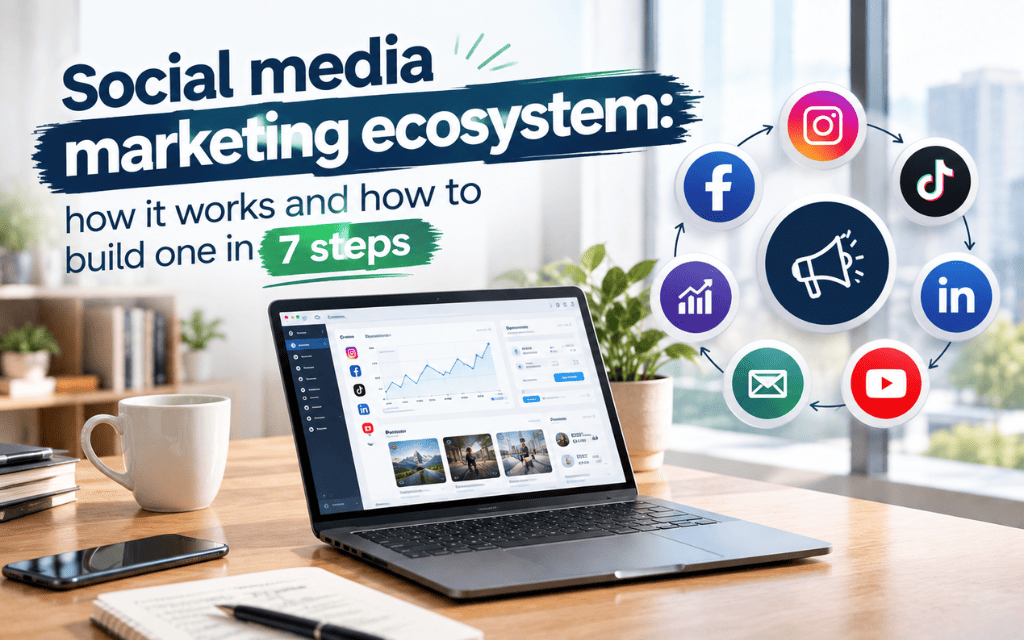
A social media marketing ecosystem connects your social profiles, website, Google Business Profile, email list, and ads so each channel passes people to the next. This guide is for small business owners who post often but see few leads. We break down the 6 core parts and give you a 7-step plan to turn followers into customers.
What is a social media marketing ecosystem?
A social media marketing ecosystem is a connected system of social platforms, content, data, and people that moves an audience from discovery to purchase. Each part has one job and hands the visitor to the next part.
Posting on Instagram is a tactic. An ecosystem is the structure behind that tactic. It decides where a post sends people, what data you collect, and how you follow up.
When our team audits social accounts for Colorado restaurants, landscapers, and service firms, we see the same gap again and again. The profiles are active, but the bio link points to a generic homepage, and nobody tracks what happens after the click.
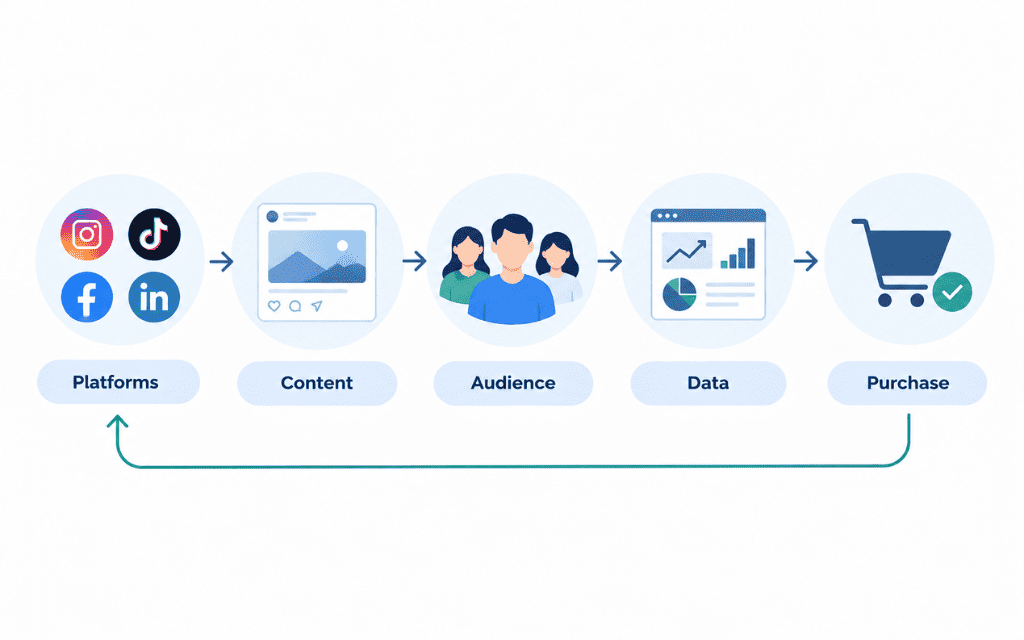
Social media ecosystem vs. simply posting on social
The difference shows up in where effort goes after a post goes live. The table below compares the two approaches on 6 practical factors.
| Factor | Posting only | Social media ecosystem |
| Goal | Likes and followers | Leads, bookings, and sales |
| Link destination | Homepage or none | A matching landing page |
| Data | Platform insights only | UTMs, GA4, and pixel events |
| Follow-up | None | Email, SMS, or retargeting |
| Content life | 1 post, 1 day | 1 idea reused in 4 to 6 formats |
| Measurement | Engagement rate | Leads and revenue by channel |
Social media ecosystem vs. digital marketing ecosystem
A digital marketing ecosystem covers every online channel, such as search ads, SEO, email, and online marketplaces. A social media marketing ecosystem is one part of that larger network. It uses social platforms as the main entry point, and both systems share the same center: your website.

How a social media ecosystem works: the hub-and-spoke model
The hub-and-spoke model places your website at the center and treats each social platform as a spoke that sends traffic back to it. Every spoke has a different owner, cost, and level of control.
Forrester analyst Sean Corcoran defined the split between owned, earned, and paid media in December 2009. The hub-and-spoke view adds one practical question to that model: who controls each spoke?
Your website: the hub you own
Your website is the only asset in the ecosystem that you fully control. Platform rules, reach, and ad prices change, but your pages, forms, and visitor data stay yours. Each social campaign should land on a page built for that exact offer, such as a menu, a quote form, or a booking calendar.
Social platforms: the spokes you rent
Social platforms such as Instagram, Facebook, TikTok, and YouTube give you reach, but they own the audience relationship. An algorithm update can cut your organic reach overnight.
Treat followers as rented attention. Your job on every platform is to turn rented attention into owned contacts, such as email subscribers, phone leads, and repeat customers.

Google Business Profile: the local bridge
Google Business Profile (GBP) links your social presence to local search results on Google Search and Maps. GBP lets you add 1 social link per platform, such as 1 Facebook page and 1 YouTube channel. Google notes that this feature is available only in select regions, as of October 2026.
For local businesses, reviews and photos on GBP do the same job as social proof on Instagram. They show a real business with real customers.
Email and SMS: where relationships continue
Email and SMS are owned channels that keep the conversation going after a social visit. A visitor who joins your list from a social post becomes a contact you can reach without paying for ads again.

The 6 core components of a social media ecosystem
A complete social media ecosystem has 6 components: content, platforms, community, paid amplification, data, and people. The table below maps each component to its job and media type.
| Component | Main job | Media type | Example |
| Content and repurposing | Gives people a reason to stop | Owned | A blog post turned into a Reel and a carousel |
| Platforms and distribution | Puts content in front of the right audience | Rented | Instagram for a bakery, LinkedIn for a law firm |
| Community and UGC | Builds trust through replies and customer posts | Earned | A tagged photo from a customer |
| Paid amplification | Extends reach and brings visitors back | Paid | A retargeting ad to recent website visitors |
| Data and tracking | Shows which link drove each lead | Owned | UTM tags read in GA4 |
| People and workflow | Keeps the system running each week | Internal | A content calendar with 1 owner |
Content and repurposing
Content is the fuel of the ecosystem. One strong idea can feed 4 to 6 formats, such as a blog post, a short video, a carousel, an email, and a GBP update. For fresh angles, our list of social media post ideas groups 35 formats by business goal.
Platforms and distribution
Platforms decide who sees your content and in what format. Choose them by audience age and intent, not by trend. The platform data section below shows who uses each network in the US.
Community engagement and UGC
Community engagement turns viewers into advocates. Fast replies to comments and DMs, customer photos, and reviews create earned media that ads cannot buy. Earned word of mouth also feeds referral marketing, where happy customers send new ones.
Paid amplification and retargeting
Paid social ads push your best content to people who have not found you yet. They also bring back visitors who left your site. Meta’s Website Custom Audiences use the Meta Pixel to match your site visitors with people on Facebook and Instagram, so you can show them a follow-up ad.
Local businesses can also limit ads to a radius, such as 10 miles (16 km) around a store. That keeps spending on people who can visit.

Data and tracking: UTMs, GA4, and pixels
Tracking connects every social click to a result on your website. Add UTM parameters to each bio link and post link, read them in Google Analytics 4 (GA4), and install the Meta Pixel for ad audiences. Without these 3 tools, your reports show likes but miss leads.
People and workflow
People keep the ecosystem alive week after week. A small business needs 1 owner, 1 content calendar, and 1 monthly review. In our experience, systems fail when “everyone” handles social, because no single person checks the hand-offs.

How social media supports SEO and what it does not do
Social media supports SEO by helping people and search engines discover your content faster. Google’s SEO Starter Guide lists social media promotion as one way to promote a website and notes that promotion leads to faster discovery.
Social activity helps search in 3 indirect ways:
- Discovery: New posts reach readers, bloggers, and journalists, who may link to useful pages.
- Brand demand: People who see your brand on social media often search for it by name later.
- Branded results: Active social profiles can appear in search results for your business name.
Google’s documentation does not list likes, shares, or follower counts as ranking signals. Treat social as a distribution engine and leave rankings to content quality, technical health, and links. Our SEO services handle that side of the system.

Which platforms belong in your social media ecosystem?
The right platforms are the ones your customers already use. US data from Pew Research Center shows large gaps by age.
| Platform | All US adults | Ages 18–29 | Ages 65+ |
| YouTube | 84% | 95% | 64% |
| 71% | 68% | 57% | |
| 50% | 80% | 19% | |
| TikTok | 37% | 63% | 12% |
| 32% | 37% | 20% |
Use the data to match platforms to buyers:
- Restaurants and cafés: Instagram and Facebook carry food photos, events, and local reach.
- Home services and landscaping: Facebook, YouTube, and GBP suit project videos and reviews.
- Law firms and B2B services: LinkedIn and YouTube fit expertise-led content.
We advise most small clients to master 1 to 2 platforms before adding a third. Two active profiles with weekly posts beat 5 profiles that go quiet after a month.

How to build a social media marketing ecosystem in 7 steps
To build a social media marketing ecosystem, start with the hub, connect the spokes, and add paid reach last. The 7 steps below follow the order we use with new clients.
1. Set 1 goal and map the journey. Pick one result, such as booked calls or table reservations. Then sketch the path from the first post to that result.
2. Fix the hub first. Build landing pages that match your offers and load fast on phones. A website built to convert makes every later step cheaper.
3. Choose 1 to 2 core platforms. Use the age data above and your best customers’ habits.
4. Build a repurposing system. Plan 1 core idea per week and cut it into 4 to 6 formats.
5. Connect tracking. Tag every link with UTMs, set up GA4 goals, and install the Meta Pixel.
6. Capture owned contacts. Add an email signup or lead form, and link your social profiles in GBP.
7. Amplify winners with paid ads. Boost the posts that already convert, then retarget site visitors.
Review the system once a month. Cut the formats that do not drive clicks and move the budget to the ones that do.

Example: how a local restaurant’s ecosystem fits together
This hypothetical example shows how one Denver restaurant could link its channels around a new seasonal menu. Each step hands the customer to the next.
- Monday: The restaurant posts a 20-second Reel of the new green chile dish. The bio link uses a UTM tag and opens the seasonal menu page.
- Tuesday: The team shares the same photos as a GBP update and replies to new Google reviews.
- Wednesday: A Facebook ad targets adults within 5 miles (8 km) who engaged with the page in the last 30 days.
- Thursday: The weekly email features the dish and a reservation button.
- Friday: Website visitors who viewed the menu but did not book see a retargeting ad.
One dish, 5 touchpoints, and 1 tracked destination: that is an ecosystem at work.

How to measure whether your social media ecosystem is working
Measure the ecosystem with leading metrics that predict results and lagging metrics that confirm them. Leading metrics move first, so they warn you early.
| Ecosystem part | Leading metric | Lagging metric |
| Social platforms | Saves, shares, and link clicks | Leads from social UTMs |
| Website | Landing page conversion rate | Booked calls or sales |
| Google Business Profile | Profile views and direction requests | Calls from GBP |
| Email and SMS | Signup rate and click rate | Repeat purchases |
| Paid ads | Click-through rate | Cost per lead |
Check leading metrics weekly and lagging metrics monthly. A drop in link clicks this week often predicts fewer leads next month.

8 signs your social media ecosystem is broken
A broken ecosystem leaks visitors between channels. These 8 signs show where the leaks start:
Broken bio links: The link-in-bio points to an old offer or a 404 page.
- Missing UTM tags: GA4 shows social traffic but not which post sent it.
- Mismatched brand details: Name, phone, or hours differ across profiles and GBP.
- One-use content: Each post gets created from scratch and used once.
- Homepage landings: Ads send people to the homepage instead of an offer page.
- No email capture: Visitors leave without a way to hear from you again.
- Silent inboxes: Comments and DMs wait days for a reply.
- No owner: Nobody reviews the full system each month.
If 3 or more signs apply, fix the hub and tracking before you post more.

When to work with a social media marketing agency
An agency makes sense when the system has more parts than your team can run each week. Three signals tell you it is time:
- Time: Social takes more than 5 hours a week from the owner.
- Skills: Nobody on the team can set up tracking, pixels, or ad audiences.
- Results: Posting is steady, but leads from social stay flat for 3 months or more.
A good partner connects the parts instead of selling posts alone. Ask any agency how it links social work to your website, SEO, and ads.

The Ocean Wide Social Marketing service
The Ocean Wide Social Marketing Service builds and runs a complete social media marketing ecosystem for small and local businesses in Denver and across Colorado. Our Denver-based team plans, produces, and connects every part so it works as one system.
Here is what we handle inside one team:
- Strategy: Platform selection, a 1-goal journey map, and a monthly content calendar.
- Content production: Photography, short video, and drone footage from our in-house creative team.
- Connection: Landing pages, UTM tracking, GA4, and Meta Pixel setup.
- Amplification: Paid social campaigns and retargeting through our digital advertising team.
- Reporting: Monthly reviews that tie social activity to leads.
Because our team also handles web design and SEO, we can fix the hub and the spokes at the same time. You work with one point of contact instead of three vendors. Learn how our Social Marketing plans fit your business on a free call.

FAQs about the social media marketing ecosystem
What is the social media ecosystem?
The social media ecosystem is the network of platforms, users, content, and tools that people use to connect online. For a business, it also includes the website, data, and follow-up channels linked to those platforms.
What are the main components of a social media marketing ecosystem?
The 6 main components are content, platforms, community, paid amplification, data tracking, and people. Each one needs a clear job and a hand-off to the next.
Does social media help SEO?
Yes, social media helps SEO indirectly. It speeds up content discovery and builds brand searches, but likes and shares are not listed as ranking signals in Google’s documentation.
How many social media platforms should a small business use?
Most small businesses should start with 1 to 2 platforms. Add a third only after the first two posts weekly and drive tracked leads.
Can a small business build a social media ecosystem without paid ads?
Yes, a small business can start without paid ads. Organic posts, GBP, and email capture form a working base, and paid ads speed it up later.
How do I know if my social media marketing ecosystem is working?
Your social media marketing ecosystem works when social clicks turn into tracked leads or sales. Check UTM-tagged leads in GA4 each month alongside engagement.