Skip to content


AI brand monitoring shows small business owners what ChatGPT, Gemini, and Google’s AI results tell customers about their company. This guide gives you a free process to check those answers, correct errors, and decide if a paid tool is worth it. We sell no monitoring tools and earn no commission from the tools named here.
What is AI brand monitoring?
AI brand monitoring is the practice of checking how AI assistants name, describe, and cite your business. You ask the questions customers ask, then record each answer and its sources.
Some marketers call this gen ai brand monitoring or AI conversational brand monitoring, because the answers come from chat tools such as ChatGPT, Claude, and Gemini. Google’s AI Overviews and AI Mode belong in the same check.
These answers often draw on live web sources. Google says its AI features use retrieval-augmented generation, which pulls pages from its index, and query fan-out, which runs related searches to build one reply.
The 3 jobs behind the term
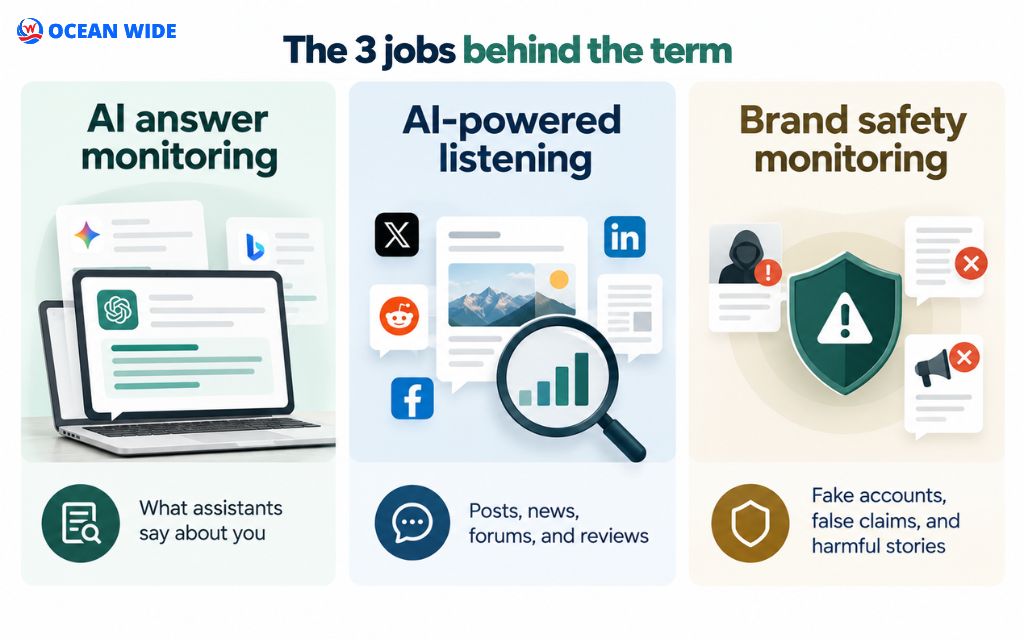
The phrase brand monitoring AI covers 3 separate jobs, and each job needs a different method. The table below shows what each one tracks and who needs it.
| Job | What you track | Who needs it | Example tools |
| AI answer monitoring | What assistants say about you | Any business customers research online | Otterly.AI, Peec AI, Serpstat AI Visibility |
| AI-powered listening | Posts, news, forums, and reviews | Brands with steady public conversation | Brandwatch, Brand24, BrandMentions |
| Brand safety monitoring | Fake accounts, false claims, and harmful stories | Brands with high reputation risk | Brand Monitoring.ai, Brandwatch |
We recommend that most small businesses start with the first job. It costs nothing, and it shows which of the other 2 jobs you need.
AI brand monitoring vs. traditional brand monitoring
Traditional brand monitoring finds what people publish about you. AI brand monitoring tests what a machine tells one person, in an answer that may never exist as a public page.
AI-powered brand monitoring sits between the two. It uses sentiment analysis to sort human posts at scale, yet it still reads published content rather than AI answers.
| Factor | Traditional monitoring | AI brand monitoring |
| Data source | Social posts, news, forums, and reviews | Answers from AI assistants |
| Detection method | Keyword alerts and crawlers | Repeated prompts you run |
| Main metrics | Volume, reach, and sentiment | Mention rate, citations, and accuracy |
| Typical fix | Reply, comment, or PR response | Page, listing, and review updates |
| Review pace | Daily during active conversations | Monthly, or weekly after big changes |

Why AI brand monitoring matters for small businesses
AI brand monitoring matters because customers can meet your business inside an answer before they reach your website. That answer can also leave your name out.
How AI technology is changing brand monitoring
The effects of AI technology on brand monitoring start with clicks. In Pew Research Center’s analysis of 900 U.S. adults, users clicked a traditional result on 8% of visits to pages with an AI summary, compared with 15% on pages without one.
Users clicked a link inside the summary on 1% of those visits. This March 2025 data is why we treat an AI answer as a brand touchpoint, even when it sends no traffic.
Customers shortlist in AI, then verify
In BrightLocal’s 2026 survey of 1,002 U.S. consumers, we found that 45% had used AI tools for local business recommendations in the past year. The figure was 6% the year before.
Google still leads. BrightLocal’s July 2026 study of 1,227 consumers shows 52% started their latest local search on Google Search, and 8% started with AI.
Verification follows the AI step. Only 18% of AI users felt ready to contact the recommended business, and 43% of people who started with AI went on to check Google.
A customer may hear your name from ChatGPT, then check your Google reviews before calling. Both sources need to tell the same story.

What to track: 6 metrics that matter
Track 6 metrics to learn if AI names you, trusts you, and describes you correctly. A spreadsheet with one row per answer can hold all of them:
- Mention rate: The share of answers that name your business at least once.
- Recommendation rate: The share of answers that suggest you as an option for the customer’s needs.
- Citation rate: The share of answers that link to your website as a source.
- Share of voice: Your mentions as a percentage of all brand mentions in your category.
- Sentiment: The tone of each mention, marked positive, neutral, or negative.
- Accuracy: The correctness of your hours, prices, services, and location.
Mention rate and share of voice also work as AI brand awareness monitoring, since they show how often your name enters the conversation. Accuracy matters most for local businesses, because one wrong phone number can cost a booking.
Why you should ignore AI rankings
Ignore AI rankings because the order of an AI list changes too often to measure. SparkToro and Gumshoe.ai ran 12 prompts 2,961 times across ChatGPT, Claude, and Google’s AI features.
Search Engine Journal reports a less than 1-in-100 chance that ChatGPT or Google’s AI returned the same brand list twice. Visibility across many runs proved more consistent, so we report a rate instead of a position.
The study has limits: it was not peer-reviewed, and Gumshoe.ai sells AI tracking tools. We still use its lesson, because a single screenshot proves little.

How to monitor your brand in AI answers for free
To monitor your brand in AI answers for free, you need 10 to 20 prompts, a spreadsheet, and free versions of major AI tools. Follow these 5 steps.
Step 1: Write 10 to 20 prompts customers would use
Write prompts in 4 groups, so you test more than your own name:
- Category prompts: “Best family dentist in Denver for young kids.”
- Comparison prompts: “Is [your business] or [competitor] better for roof repair?”
- Branded prompts: “What do customers say about [your business]?”
- Local prompts: “Best plumber within 10 miles (16 km) of Lakewood, Colorado.”
Keep your name out of category prompts. A prompt that names you will often return your name, and that result measures nothing.
Step 2: Run each prompt in the tools customers use
Start with ChatGPT and Google AI Mode, the 2 tools BrightLocal found most used for business recommendations, at 31% and 23%. Add Gemini, Perplexity, Copilot, or Claude when your audience uses them.

Step 3: Repeat each prompt and log every answer
Run each prompt 3 to 5 times, because one answer is a sample and not a result. This count is our working rule, since researchers have not set a standard.
Log the date, tool, prompt, brands named, cited URLs, and factual errors. Save the full answer text, so you can review the wording later.
Step 4: Check the Generative AI report in Search Console
Open the Generative AI performance report in Google Search Console. It shows impressions, pages, countries, devices, and dates for AI features in Search and Discover.
The report has no click or query data, so pair it with your prompt log. Google finished the global rollout on August 31, 2026, and sites with little data may not see it.

Step 5: Review trends every month
Review your log once a month and compare rates, not single answers. Check weekly after a rebrand, price change, office move, or press story.
How to fix what AI gets wrong
To fix what AI gets wrong, correct the sources it reads, because you cannot edit an assistant’s answer directly. Changes take time to appear, so retest your prompts after a few weeks.
Match each problem to its fix
Each pattern in your log points to a different first move. Use this table to choose where to start.
| Problem in your log | Likely cause | First fix |
| Not mentioned | Thin service pages or few listings | Clarify service pages and earn relevant listings |
| Wrong facts | Old pages or outdated directories | Update your site, profile, and directories |
| Negative tone | Real complaints in reviews | Fix the issue and reply to reviews |
| Competitor favored | Stronger comparison content | Publish a fair comparison with proof |
Start with sources you control
Start with your website, Google Business Profile, and main directories. Google says Business Profile details can help your services stay visible in AI responses and other Search results.
Keep your name, address, phone, hours, and services identical everywhere. This cleanup overlaps with Denver SEO services and website design and development, since clear pages help people and machines read your business.

Check that AI crawlers can reach your site
Check robots.txt and your CDN or hosting firewall, because a block can hide your pages. OpenAI says sites that opt out of OAI-SearchBot will not appear in ChatGPT search answers, though they can still show as navigational links.
GPTBot is a separate crawler tied to model training, so your choice there does not set your ChatGPT search access. For Google, confirm your site stays included in the Search generative AI setting in Search Console.

What you can skip
You can skip 3 popular tactics for Google Search, according to Google’s 2026 guide:
- LLMS.txt files: Google Search ignores them, so they neither help nor harm your visibility.
- Content chunking: Google can read several topics on one page without tiny sections.
- Inauthentic mentions: Google’s spam and quality systems limit the value of manufactured mentions.
This guidance covers Google Search only, and other AI tools may work differently. Google also warns that no third-party tool has access to its internal ranking or AI systems.
When a false claim turns serious
Escalate when an AI answer states something false that could cost you customers. In 2025, Minnesota solar company Wolf River Electric sued Google, alleging an AI Overview falsely said the state attorney general had sued it. Google denied the allegations.
Save dated screenshots, report the answer through the tool’s feedback option, and speak with a lawyer. We are marketers, not attorneys, so treat this as a first step and not legal advice.

AI brand safety and narrative monitoring
AI brand safety and narrative monitoring tracks false or harmful stories before they spread, such as fake accounts, misleading posts, and copied branding. A narrative is the repeated story people and machines tell about your company.
An AI brand safety and narrative monitoring tool, such as BrandMonitoring.ai, scans social, news, and app stores and can support takedown work. Most local businesses need a lighter version: alerts, profile checks, and our guide to mentions on social media.
In Capterra’s 2023 survey of 299 U.S. marketing professionals, we found that 57% had seen criticism or defamatory content about their brand on social media, and 49% had met a fraudulent brand account. The same survey shows 93% believed brand monitoring still requires human analysis.

AI brand monitoring tools: how to choose
Choose AI brand monitoring tools by the job you need done, not by a best-of list. Many lists on this topic come from vendors that rank their own product first.
We did not test these tools for this guide, so treat the table as a starting map. Prices change often, so confirm them on each vendor’s site.
Tools by job
This table groups common options by job. Pricing reflects what we saw in late 2026.
| Job | Tools | Starting point |
| Free baseline | Search Console and a spreadsheet | $0 |
| AI answers only | Otterly.AI, Peec AI | About $29 and $95 per month in published comparisons |
| AI answers plus SEO | Serpstat AI Visibility, Semrush, Ahrefs Brand Radar | Serpstat Team: $129 per month for 1,500 checks |
| Local AI visibility | BrightLocal | 14-day trial for up to 20 prompts |
| Social and web listening | Brand24, BrandMentions, Brandwatch | Brand24: about $199 per month billed annually |
5 questions to ask before you pay
Ask vendors these 5 questions before you sign. The answers reveal what the dashboard number really means.
1. Which AI tools does my plan include, and which cost extra?
2. How many times does the tool run each prompt?
3. Can I read the full saved answer text?
4. Does the tool show the exact URLs each answer cited?
5. What will I pay for my real prompt count?

Do you need a paid tool yet?
You likely do not need a paid tool if you track fewer than 20 prompts. In our view, a spreadsheet handles that volume for a single-location business.
Pay when manual checks eat too much staff time, or when you need alerts, daily tracking, or client reports. Run your manual baseline first, so you know what the tool should improve.
When to work with an agency
Work with an agency when your log shows problems your team cannot fix alone. These 4 signs suggest it is time:
- Repeated errors: AI keeps repeating wrong facts after you update your main sources.
- Thin pages: Your website lacks clear pages for each service and location.
- Limited time: Nobody on your team can run monthly checks.
- Public complaints: Social conversation or reviews need steady, skilled replies.
Bring your prompt log to the first call. It shows the agency what AI says today and gives both of you a baseline.

How our Social Marketing Service supports your brand
Our Social Marketing Service supports AI brand monitoring by managing the public conversation customers see on social platforms. The service covers social listening, sentiment tracking, content creation, comment and DM management, and reporting.
We manage Facebook, Instagram, TikTok, LinkedIn, YouTube, and Pinterest. Our process runs through 5 phases: discovery, strategy, content and campaign setup, launch and optimization, and reporting.
Social marketing cannot force an AI assistant to recommend you, and no agency can promise that. It gives you accurate profiles, steady content, and a clear record of how people talk about your brand, and organic growth typically takes 3 to 6 months.

Frequently asked questions about AI brand monitoring
How is AI brand monitoring different from social listening?
AI brand monitoring checks generated answers, while social listening checks human posts. Social listening reads social platforms, forums, and news. The two overlap, since AI tools can cite those same sources.
Can I monitor my brand in ChatGPT for free?
Yes, you can monitor your brand in ChatGPT for free with manual checks. Run 10 to 20 customer prompts several times each, then log the answers in a spreadsheet.
How often should I check what AI says about my business?
Check once a month for steady operations. Check weekly after a rebrand, price change, location move, or news story. Monthly reviews give you enough runs to see a trend.
How much do AI brand monitoring tools cost?
Manual checks cost $0, and entry plans in late 2026 commonly start under $100 per month. Add-ons for extra AI tools can raise that price, so compare the total for your prompt count.
Can I correct wrong information about my business in AI answers?
You can correct the sources, not the answer itself. Update your website, Google Business Profile, and directories, then retest. Use the tool’s feedback option for serious errors.
Do small businesses really need AI brand monitoring?
Yes, AI brand monitoring shows you which facts to correct, but you fix the sources, not the answer itself. Update your website, Google Business Profile, and directories, then retest. Use the tool’s feedback option for serious errors.