Skip to content


A strong social media presence is not defined by how many numbers appear on a dashboard, but by what those numbers reveal about audience behavior and business impact. At The Ocean Wide, we see social metrics as signals that help brands understand what earns attention, what drives action, and what deserves further investment.
If you are learning how to measure social media, start by connecting every metric to a clear goal, then use the data to make smarter decisions about content, channels, and growth.
What Does Social Media Measurement Really Tell You?
Social media measurement helps you understand whether your content and campaigns are moving your business toward a specific goal. Instead of asking whether a post “did well,” you can look at data to understand how many people saw it, how they interacted, whether they visited your website and whether they completed a valuable action.

Numbers matter most when they help answer a business question. Ten thousand impressions may look impressive, for example, but they mean little if your goal was generating qualified leads and nobody clicked through. That is why social engagement metrics should always be read in the context of the outcome you actually want.
Start With The Goal: What Are You Actually Trying To Measure?
Every social media objective needs its own set of KPIs. A campaign designed to build awareness should not be judged by the same numbers as one created to generate sales. A simple framework keeps social media measuring focused: define the objective first, then choose the metrics that show progress toward it.

Brand Awareness
Brand awareness shows how widely your content reaches potential customers and how often people come across your brand on social media. If you are figuring out how to measure social media visibility, start with reach, impressions, follower growth, and brand mentions to see whether awareness is building over time.
Focus less on isolated spikes and more on consistent trends. A steady increase in relevant reach usually tells you more than one post that suddenly gets a large number of views.
Audience Engagement
Audience engagement shows whether people care enough about your content to interact with it. Likes can offer a quick signal, while comments, shares, saves, clicks, and direct messages often reveal stronger interest.
When measuring social media engagement, pay attention to both volume and quality. A post with fewer reactions but more thoughtful comments or saves may create more value than one with many passive likes.
Website Traffic And Leads
Not every social interaction should end on the platform itself. If you are looking at how to measure social media beyond likes and comments, website traffic can show whether people are taking the next step and moving closer to becoming a lead.
Focus on link clicks, referral traffic, landing-page visits, form submissions, newsletter sign-ups, and other lead actions. These signals help reveal which platforms and campaigns are bringing in visitors with real intent.
Conversions And Revenue
Social media performance carries greater business value when it can be tied to measurable outcomes. Purchases, bookings, quote requests, phone calls, subscriptions, and completed forms can all serve as conversion points, depending on the objectives of the campaign.
When assessing how to measure social media, conversion and revenue data provide a stronger indication of commercial impact than engagement alone. These metrics should be evaluated alongside traffic and audience behavior to show how social activity contributes to the broader customer journey and business growth.
Which Social Media Metrics Should You Actually Track?
Instead of tracking every number available, focus on metrics that show whether your content is reaching the right people, encouraging interaction, and supporting real business goals. For anyone deciding how to measure social media, the following KPIs provide a practical starting point.
Reach And Impressions
Visibility comes first when you want to know how far your content is traveling. If you are working out how to measure social media, reach shows how many unique users see a post, while impressions count the total number of times it appears on screen. These metrics are useful for awareness, but context matters. High impressions with very little interaction may mean people are seeing the content without finding it relevant enough to engage.

Follower Growth
Follower growth shows whether your audience is expanding over time. Rather than focusing only on the total follower count, track the follower growth rate to see whether your audience is increasing, slowing down, or declining.
Growth becomes more meaningful when it is reviewed alongside social engagement metrics. A larger audience offers limited value when new followers rarely interact with your content or fall outside your target market.
Engagement Metrics
Likes are easy to notice, but they only tell part of the story. Comments, shares, saves, clicks, and direct interactions usually give better insight into how strongly your audience responds.
To understand how to measure social media engagement more clearly, engagement rate gives you a stronger benchmark than raw likes or comments alone.
Engagement Rate = Total Engagements ÷ Total Followers × 100
When you measure engagement, look beyond the percentage itself. A post with fewer likes but more shares or saves may create more value than one with a high number of passive reactions.

Clicks And Ctr: Does Your Content Drive Action?
Clicks show whether people are interested enough to move beyond the social post. Click-through rate, or CTR, adds context by showing what percentage of people who saw the content actually clicked.
A common formula is:
CTR = Total Clicks ÷ Total Impressions × 100
When considering how to measure social media beyond surface-level engagement, CTR is especially useful because it connects attention with action. A post may earn fewer likes yet still perform better if it consistently sends qualified visitors to a website, service page, or campaign landing page.
Conversion Rate
Once people leave the platform, the next question is simple: what do they do next? Purchases, bookings, sign-ups, form submissions, and quote requests can all count as conversions, depending on the campaign.
Conversion Rate = Total Conversions ÷ Total Visitors or Clicks × 100
This is where how to measure social media starts to connect more clearly with business performance. Reach and engagement show interest, while conversion rate reveals whether that interest is turning into meaningful outcomes.

What Tools Can Help You Measure Social Media?
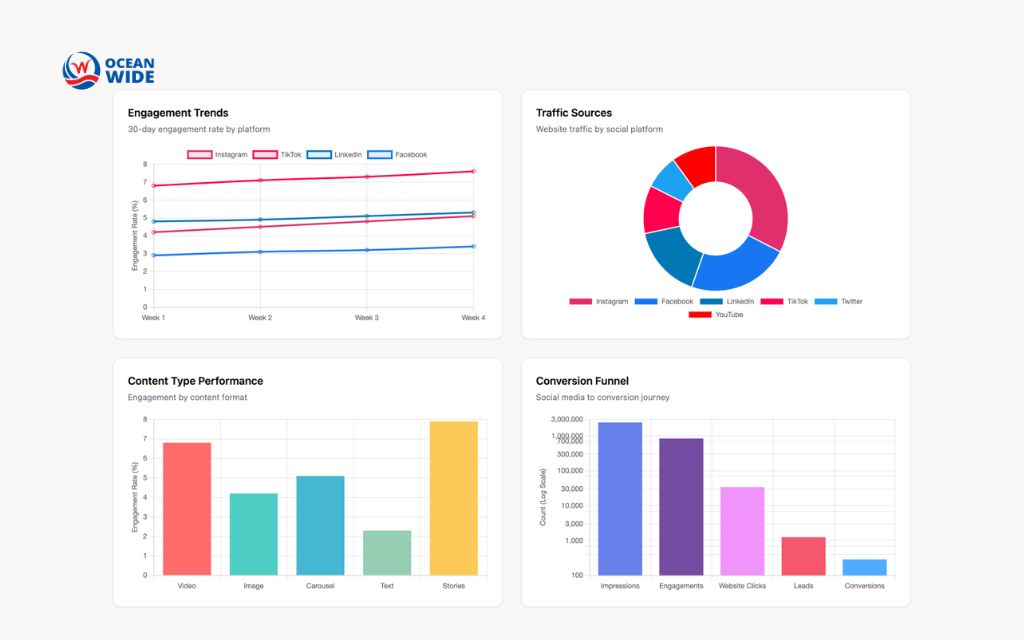
No single tool gives a complete view of social performance. Native platform analytics explain what happens inside each network, Google Analytics shows what happens after people reach your website, and management or listening tools help connect data across channels.
Native Social Media Analytics
Native analytics are a practical starting point for how to measure social media because they provide first-party data on reach, impressions, clicks, engagement, follower growth, and audience demographics. They are especially useful for quick, day-to-day performance checks. For example, LinkedIn tracks content, followers, visitors, search appearances, competitors, and engagement. Some metrics may take up to 48 hours to fully appear, so avoid judging performance too early.

Google Analytics
Social platforms tell you what happens before the click; Google Analytics helps explain what happens afterward. GA4 currently separates traffic into channel groups such as Organic Social, Paid Social, Organic Video, and Paid Video, making it easier to compare social traffic with search, email, referral, and other acquisition sources.

For businesses that want to measure social media beyond engagement, GA4 can help track:
- Traffic coming from social channels
- Campaign and source data
- Landing-page behavior
- Key events and conversions
- New, qualified, and converted leads
Social Media Management And Listening Tools
Social media management tools such as Sprout Social, Hootsuite, Buffer, Agorapulse, and HubSpot make it easier to measure social media across several platforms from one dashboard. They can bring together reach, clicks, follower growth, campaign performance, and social engagement metrics for easier comparison.
For tracking social media engagement beyond your own posts, listening tools such as Brandwatch, Mention, Talkwalker and YouScan can monitor brand mentions, competitor activity, keywords, sentiment, and broader audience conversations.
Common Social Media Measurement Mistakes To Avoid
Even experienced teams can misread performance when the wrong numbers get too much attention. A clearer approach to how to measure social media starts with avoiding a few common mistakes that can distort what the data is really telling you.
- Tracking too many metrics: Focus on KPIs tied to a clear goal.
- Overvaluing follower count: For measuring audience engagement, prioritize comments, shares, saves, and clicks.
- Ignoring sentiment: High engagement can still reflect negative reactions.
- Comparing raw numbers: Use a social media engagement metric such as engagement rate for fairer comparisons.
- Skipping benchmarks: Compare results with past performance or relevant industry standards.
Get More Value From Your Social Media Data With The Ocean Wide
Many businesses already have plenty of social media data but still struggle to answer the questions that matter most: Which content is actually working? Which platform deserves more budget? How do you measure engagement in a way that reflects real audience interest? And which numbers should the team act on next?
The Ocean Wide helps turn scattered metrics into a clearer decision-making process with our Social Marketing Service. Instead of reporting on likes and follower growth alone, our team connects audience behavior, content performance, traffic, and campaign results with your broader marketing goals.
- Focused performance tracking: Prioritize the metrics that connect directly to your marketing goals.
- Content performance analysis: Identify the topics, formats, and campaigns that consistently attract stronger engagement.
- Cross-platform comparison: See which social channels deserve more attention, time, and budget.
- Traffic and conversion insights: Connect social activity with website visits, leads, and other meaningful actions.
- Actionable reporting: Turn performance data into clear recommendations for future content and campaigns.

Final Thoughts
Effective measurement comes down to connecting the right metrics with the right goals. Once you understand how to measure social media, it becomes easier to see what deserves more attention, what needs to change, and where your marketing efforts are creating real value.
Need a clearer view of your social media performance? Contact The Ocean Wide at (720) 334-0899 to build a more focused, data-driven social strategy.