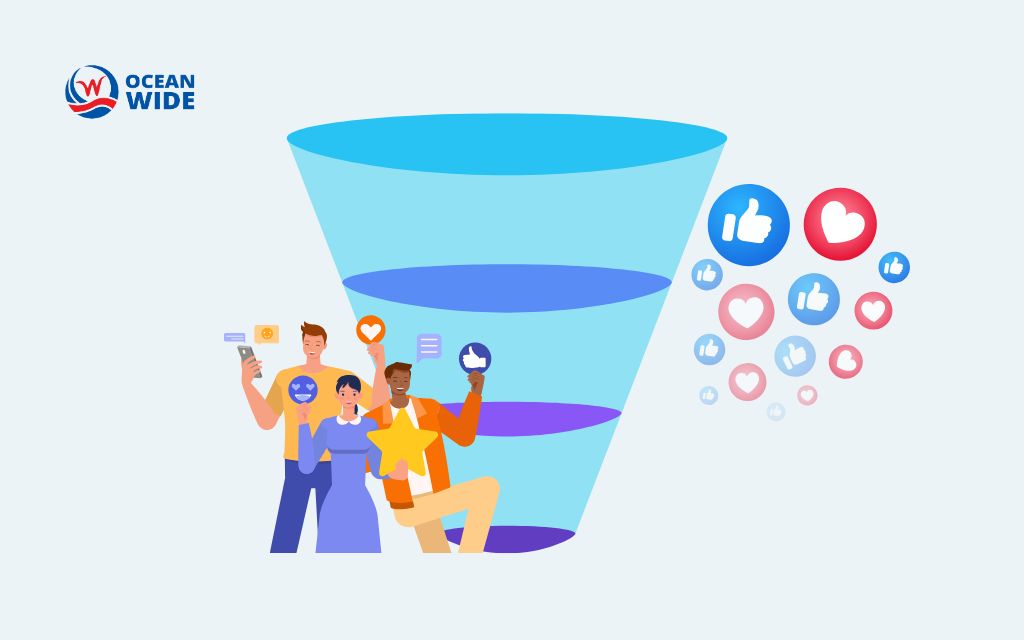
For many Denver startups and Colorado small businesses, social media feels busy but not profitable. You post regularly, your follower count grows, yet inquiries and sales stay flat. A social media funnel changes that by mapping the journey from first scroll to loyal customer, so every post, story, and ad has a clear job to do.
Instead of guessing what to post next, you design stages: awareness, engagement, consideration, conversion, and advocacy. You build content, offers, and touchpoints for each. This article breaks down how social media funnels work, why they matter for local businesses, and how to design one that fits your budget, goals, and audience.
Along the way, you will see practical examples, uncommon funnel tips, and local insights tailored to Denver and Colorado. If you want help turning your social presence into a real growth engine, The Ocean Wide in Denver is ready to partner with you. Call us anytime at (720) 334-0899 or email [email protected] to start the conversation.
What is a social media funnel?
A social media funnel is a structured process that guides potential customers from first discovering your brand on social channels to becoming paying, loyal customers. It mirrors the traditional marketing funnel but uses social-first touchpoints such as posts, stories, DMs, and ads at each stage of the customer journey.
Unlike generic sales funnels that span multiple channels, a social media funnel happens inside platforms like Facebook, Instagram, LinkedIn, and TikTok. It relies heavily on two-way interactions, not just broadcasting content. Comments, DMs, polls, and lives move people down the funnel. Retargeting ads bring back people who showed interest but didn’t convert.
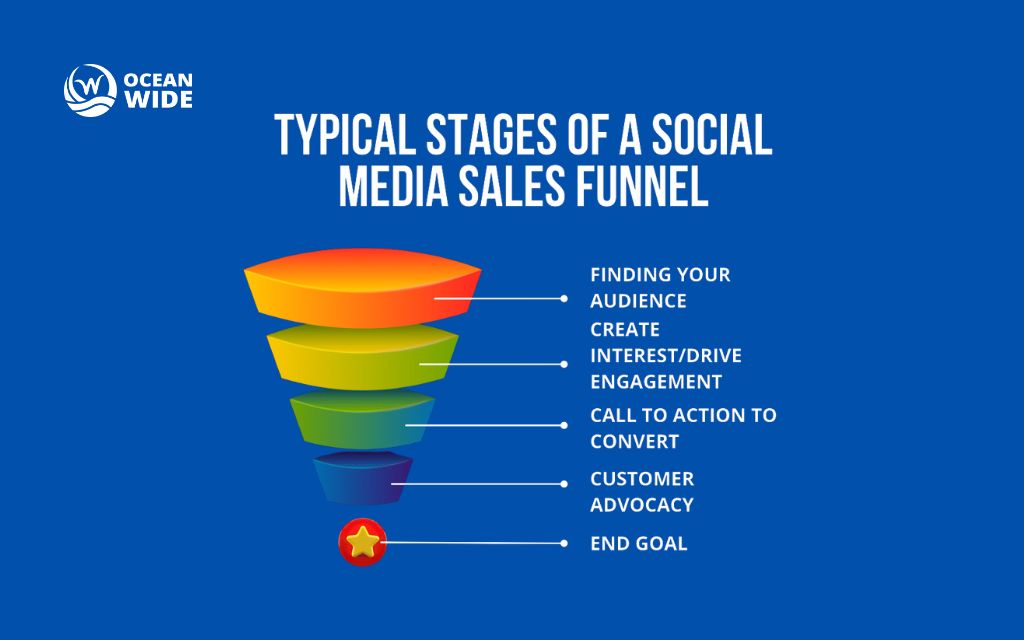
The core stages are awareness, engagement, consideration, conversion, and advocacy. Each stage has specific goals, content types, and metrics. For Denver small businesses, this framework turns scattered social activity into a predictable lead generation system.
Social media funnel vs. traditional marketing funnel
A traditional marketing funnel covers the full path from first awareness to purchase across all channels: search ads, email, events, direct mail, and more. The stages are typically awareness, consideration, conversion, loyalty, and advocacy.
A social media marketing funnel focuses specifically on the touchpoints and content inside social platforms. The stages align with the broader funnel, but the tactics are social-first. For example, awareness might come from a viral reel, consideration from a carousel of customer testimonials, and conversion from a retargeting ad with a limited-time offer.
The key differences are content formats and engagement style. Social media funnels use short videos, carousels, stories, and lives. They allow continuous, multi-format storytelling across devices, which shortens the path from awareness to conversion for small businesses. Platform algorithms amplify content that sparks engagement, giving even lean teams a chance to reach thousands of local users without big ad budgets.
For time-strapped Denver business owners, a well-optimized social media funnel can act as a primary growth engine, replacing or reducing reliance on expensive outbound channels by nurturing leads inside platforms they already use daily.
TOFU, MOFU, BOFU explained in plain English
Top-of-funnel (TOFU) is where strangers discover your brand. Think of a Denver coffee shop posting a quick reel about their signature latte art. The goal is reach and brand awareness. Content is educational, entertaining, or inspirational, designed to attract new eyes.
Middle-of-funnel (MOFU) is where interested people learn more and compare options. The same coffee shop might share a carousel of customer reviews, a behind-the-scenes video of their roasting process, or a story about sourcing beans from a local supplier. The goal is engagement and trust-building. Content is proof-focused and interactive.
Bottom-of-funnel (BOFU) is where warm leads convert into customers. The coffee shop runs a retargeting ad offering 15% off to people who visited their website or engaged with recent posts. They add a clear call to action: “Order online or visit us at our Capitol Hill location.” The goal is sales, bookings, or sign-ups. Content is offer-driven and action-oriented.
Mapping TOFU, MOFU, and BOFU to social content types makes planning simple. Reels and trending audios work for TOFU. Testimonials, case studies, and Q&A lives work for MOFU. Retargeting ads, limited-time offers, and DM campaigns work for BOFU.
Need help mapping your content to each funnel stage? The Ocean Wide can audit your current social media strategy funnel and build a plan that drives results. Reach out at (720) 334-0899 or [email protected].
Why Denver small businesses need a social media funnel
Denver and Colorado small businesses face noisy feeds and local competition. A coffee shop in RiNo competes with dozens of others for attention. A home service provider in Lakewood fights to stand out against national franchises. Random posting won’t cut it. A structured funnel gives you an edge.
Consider a Denver wellness studio. They post regularly: workout tips, motivational quotes, class schedules. Followers engage, but bookings stay low. Why? There’s no funnel. Awareness content (tips and quotes) attracts followers, but there’s no consideration content (client transformations, instructor stories) or conversion content (trial class offers, retargeting ads). People scroll, enjoy, and forget.
With a social media funnel, the same studio posts workout tips for awareness, shares client success stories for consideration, and runs retargeting ads offering a free trial class to people who watched their videos. Each piece of content has a purpose. Bookings climb because the funnel guides people from interest to action.
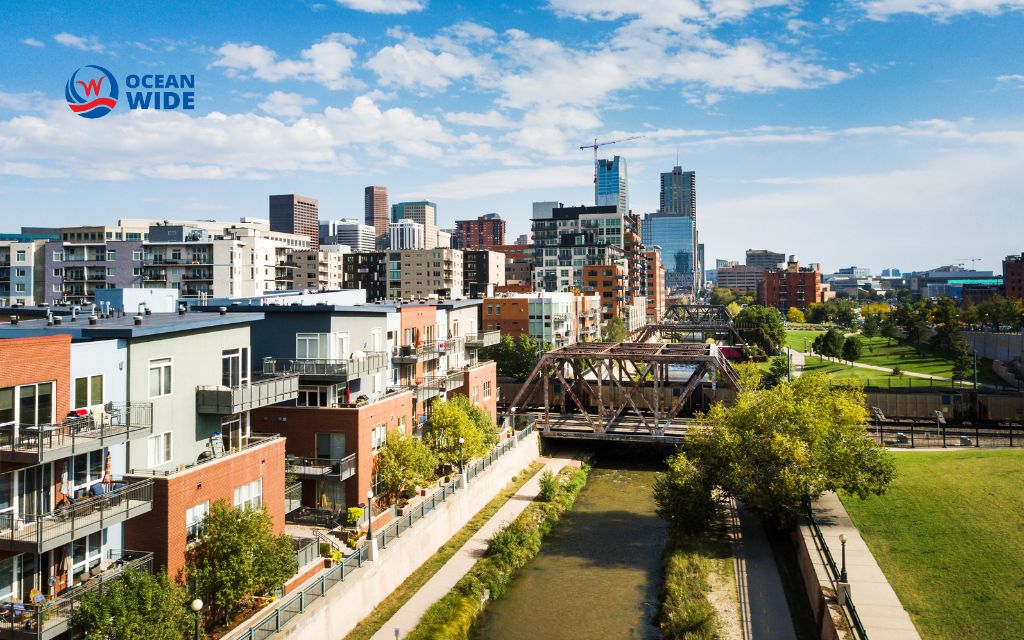
The local advantage: hyper-targeted social funnels
A social media funnel can be designed to be hyperlocal, aligning content, offers, and targeting with a specific city’s culture, events, and neighborhoods. This is where Denver businesses have a unique advantage.
Use geotargeted ads to reach people within five miles of your location. Reference local events in your posts: Rockies games, First Friday Art Walks, Denver Startup Week. Use neighborhood hashtags like #CapitolHillDenver or #HighlandsDenver. Feature customer stories from recognizable Denver spots.
Combining local SEO with your marketing funnel social media creates a cohesive local growth system. Your Google Business Profile, NAP citations, and local backlinks drive search traffic. Your social media funnel nurtures that traffic and converts it into leads. When someone searches “best coffee shop Capitol Hill,” they find you on Google. When they scroll Instagram, they see your reel. When they visit your website, a retargeting ad reminds them to visit.
This integrated approach is especially powerful for Denver service businesses: plumbers, HVAC companies, home cleaners, personal trainers, and salons. Local trust matters, and a hyperlocal funnel builds it faster than generic national campaigns.
Common funnel problems for Colorado startups
Many Colorado startups face the same funnel gaps. Here are the most common issues and what they signal:
High reach but low clicks. Your posts get views, but nobody visits your website or books a call. This signals weak consideration content. People are aware of you but don’t trust you enough to take the next step. Solution: add testimonials, case studies, and proof content to the middle of your funnel.
Many followers but few inquiries. Your follower count grows, but DMs and form fills stay flat. This signals missing or unclear calls to action. People engage with your content but don’t know what to do next. Solution: add clear CTAs to every post, use link-in-bio tools, and run retargeting ads with specific offers.
Leads that go cold after one interaction. Someone comments, DMs, or clicks your ad, then disappears. This signals no MOFU nurture content or follow-up system. You caught their interest but didn’t sustain it. Solution: build email sequences, DM automations, and retargeting campaigns that keep you top-of-mind during the consideration stage.
If any of these problems sound familiar, your social media funnel needs work. The good news is that fixing even one weak stage can unlock significant growth. Contact The Ocean Wide at (720) 334-0899 to identify your funnel gaps and build a plan to close them.
The core stages of a high-converting social media funnel
A high-converting social media funnel moves people through five stages: awareness, engagement, consideration, conversion, and retention. Each stage has specific goals, content types, and metrics. Understanding these stages is the foundation of any effective funnel strategy.
Stage 1: Awareness (getting in front of the right people)
Awareness is when new people discover your brand through content, hashtags, shares, and ads. The goal is reach and visibility. You want to show up in front of your ideal audience, whether they’re Denver locals searching for a service or Colorado startup founders looking for marketing help.
High-level tactics for awareness:
- Post short, engaging videos (reels, TikToks, YouTube shorts) on trending topics in your industry
- Use local hashtags like #DenverSmallBusiness, #ColoradoStartups, #DenverEats
- Collaborate with other Denver businesses or influencers for cross-promotion
- Run awareness ads targeting interests and behaviors that match your ideal customer
- Share educational content that answers common questions in your niche
For a Denver restaurant, awareness content might be a reel showing your chef preparing a signature dish, a carousel of your best menu items, or a story highlighting your outdoor patio during summer. For a B2B startup, it might be a LinkedIn post sharing a quick industry insight or a thread on Twitter about a challenge your product solves.
The key is to make content easy to consume and share. Keep it under 60 seconds for video, use strong hooks in the first three seconds, and always include a caption that adds context.
Stage 2: Engagement (turning views into conversations)
Engagement is when people interact with your content through comments, saves, shares, DMs, replies to polls, and participation in lives. These interactions show growing interest. They also signal to platform algorithms that your content is valuable, which boosts reach.
Interactive content formats and tactics:
- Ask questions in captions and respond to every comment
- Run polls and quizzes in Instagram or LinkedIn stories
- Host live Q&A sessions where you answer audience questions in real time
- Share user-generated content and tag the original creators
- Reply to DMs promptly and personally, even if it’s just a quick thank you
For a Denver home service business, engagement content might be a post asking, “What’s your biggest home maintenance headache?” or a poll in stories asking followers to vote on which project to feature next. For a Colorado wellness brand, it might be a live session demonstrating a quick workout or a post inviting followers to share their fitness goals in the comments.
The goal is to build relationships, not just rack up vanity metrics. A hundred engaged followers who comment and DM are worth more than a thousand passive scrollers. Engagement is the bridge between awareness and consideration. It warms people up so they’re ready to learn more about your solution.
Stage 3: Consideration (building trust and proof)
Consideration is when people ask, “Is this the right solution for me?” They compare options, read reviews, and look for proof that you deliver. This stage is critical for Denver businesses competing in crowded markets.
Recommended content for consideration:
- Case studies and client success stories with before-and-after results
- Video testimonials from Denver customers who share their experience
- Behind-the-scenes posts showing your process, team, or values
- Comparison posts that address common objections or competitor differences
- Detailed product or service walkthroughs
For a Denver marketing agency, consideration content might be a carousel showing a client’s social media growth over three months, a video testimonial from a Colorado startup founder, or a blog post breaking down your strategy process. For a local salon, it might be a reel showing a hair transformation, a post featuring glowing Google reviews, or a story highlighting your eco-friendly product line.
Social proof and reviews are powerful in this stage. People trust other customers more than they trust brands. Showcase your best work, highlight real results, and let happy customers tell your story.
Stage 4: Conversion (turning followers into customers)
Conversion is when followers become customers. They book a call, make a purchase, sign up for a trial, or visit your location. This stage requires clear offers, strong calls to action, and optimized landing pages.
BOFU tactics for conversion:
- Run retargeting ads to people who visited your website, watched your videos, or engaged with your posts
- Offer limited-time discounts or bonuses to create urgency
- Use landing pages with a single, clear CTA (no distractions)
- Add booking links, contact forms, or shop buttons directly to your social profiles
- Send personalized DMs to warm leads with a specific offer or invitation
For a Denver SaaS startup, conversion content might be a retargeting ad offering a free 14-day trial to people who visited your pricing page. For a Colorado fitness studio, it might be an Instagram ad offering a free first class to people within five miles of your location.
Optimize every touchpoint for action. Use strong, specific CTAs: “Book your free consultation,” “Claim your discount,” “Start your trial today.” Remove friction by keeping forms short and checkout processes simple. Track conversions using UTM parameters, Meta pixel, and Google Analytics so you know what’s working.
Ready to turn your followers into customers? The Ocean Wide specializes in building conversion-optimized social media funnels for Denver businesses. Call (720) 334-0899 or email [email protected] to get started.
Stage 5: Retention and advocacy (turning customers into fans)
Retention and advocacy happen after the purchase. This stage keeps customers engaged, encourages repeat business, and turns happy customers into public promoters. Many social media funnels now extend beyond the purchase into structured community-building and advocacy.
Loyalty content and tactics:
- Feature customer spotlights or success stories in your posts
- Create exclusive offers or early access for existing customers
- Build a private Facebook group or community for customers to connect
- Ask for reviews and testimonials, then share them publicly
- Launch referral programs that reward customers for bringing in new business
For a Denver e-commerce brand, advocacy content might be a UGC campaign where customers post photos with your product using a branded hashtag. For a Colorado B2B service, it might be a LinkedIn case study featuring a long-term client or a referral program offering discounts for introductions.
Advocacy turns your customers into a growth engine. Word-of-mouth and social shares from real users carry more weight than any ad. Invest in this stage, and your acquisition costs drop while your customer lifetime value climbs.
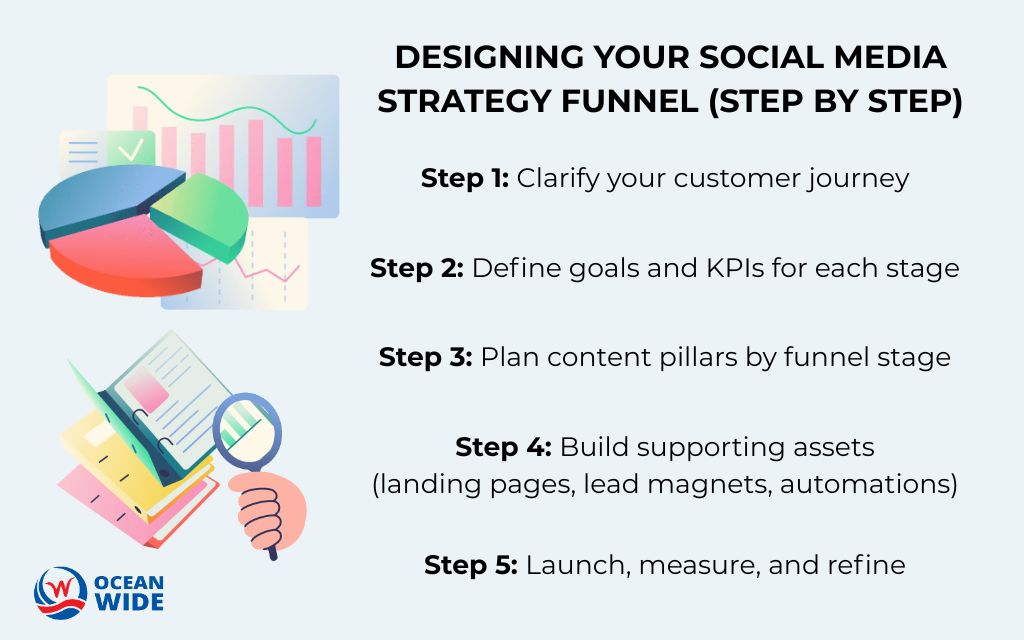
Designing your social media strategy funnel (step by step)
Building a social media funnel from scratch can feel overwhelming, especially for lean teams. This step-by-step process simplifies it. You’ll map your customer journey, set goals, plan content, build supporting assets, and launch with confidence.
Step 1: Clarify your customer journey
Start by mapping your audience’s journey from first discovery to repeat purchase. What social touchpoints do they encounter at each stage? Where do they drop off?
For a Denver home service business, the journey might look like this:
- Awareness: A homeowner sees your reel about winterizing pipes on Instagram
- Engagement: They save the post and comment with a question
- Consideration: They visit your profile, read reviews, and watch a testimonial video
- Conversion: They click your booking link and schedule a service
- Retention: After the service, they join your email list for seasonal tips
- Advocacy: They leave a Google review and tag you in a story thanking your team
Write out your customer journey in simple steps. Identify which social platforms they use, what content they engage with, and where friction occurs. This becomes your roadmap for designing content and offers.
Step 2: Define goals and KPIs for each stage
Each funnel stage needs specific goals and KPIs. Measuring funnel performance keeps you focused and helps you spot weak points.
Sample goals and KPIs by stage:
| Stage | Goal | KPIs |
| Awareness | Reach new audiences | Impressions, reach, video views |
| Engagement | Build relationships | Comments, shares, saves, DM replies |
| Consideration | Establish trust | Profile visits, website clicks, video completion rate |
| Conversion | Generate customers | Leads, bookings, purchases, cost per acquisition |
| Advocacy | Drive referrals | Reviews, UGC posts, referral clicks, repeat purchases |
Track these metrics using platform analytics (Facebook Insights, Instagram Insights, LinkedIn Analytics), Google Analytics, and UTM tracking. Check performance weekly, adjust tactics monthly, and review your full funnel quarterly.
Step 3: Plan content pillars by funnel stage
Content pillars are themes that guide your posting. Assign each pillar to a funnel stage so every piece of content has a purpose.
Sample content pillars for a Denver wellness studio:
- Education (TOFU): Workout tips, nutrition basics, wellness myths debunked
- Proof (MOFU): Client transformations, instructor spotlights, facility tours
- Offers (BOFU): Trial class promotions, membership discounts, referral bonuses
- Community (Advocacy): Member spotlights, event recaps, challenges and contests
For each pillar, brainstorm 2 to 3 content ideas. For example, under “Education,” you might post a reel on proper squat form, a carousel on meal prep tips, and a blog post on benefits of strength training. Under “Proof,” you might share a video testimonial, a before-and-after photo series, and a story showing your studio’s amenities.
Aim for a content mix: 40% awareness, 30% engagement and consideration, 20% conversion, and 10% advocacy. Adjust based on your business stage and goals.
Step 4: Build supporting assets (landing pages, lead magnets, automations)
Social content drives traffic, but supporting assets convert it. A strong social media funnel includes optimized landing pages, lead magnets, email sequences, and booking flows.
Key supporting assets:
- Landing pages: Create dedicated pages for specific offers (free trial, consultation, download) with one clear CTA
- Lead magnets: Offer valuable freebies (checklists, guides, templates) in exchange for email addresses
- Email sequences: Nurture leads with a series of helpful emails that build trust and drive action
- Booking flows: Use tools like Calendly, Acuity, or Square to make scheduling easy
- Chatbots or DM automations: Use ManyChat or Instagram automations to reply instantly to common questions
For a Denver marketing agency, a lead magnet might be a free “Social Media Funnel Audit Checklist.” A landing page promotes it, collects emails, and triggers a welcome email sequence that shares tips, case studies, and an invitation to book a strategy call.
Optimized landing pages and CTAs dramatically improve BOFU performance. A/B test headlines, offers, and page layouts to find what converts best.
Need help building landing pages or automations that convert? The Ocean Wide can design and implement the full system for you. Contact us at (720) 334-0899 or [email protected].
Step 5: Launch, measure, and refine
Launch your funnel with a pilot campaign. Test content, offers, and audiences, then iterate based on performance metrics.
Start with one month of planned content across all five stages. Post consistently, track results, and take notes on what resonates. After 30 days, review your KPIs.
- Which posts drove the most engagement?
- Which ads generated the most leads?
- Which stage is underperforming?
Refine your approach by doubling down on what works and fixing what doesn’t. If awareness is strong but consideration is weak, add more testimonials and proof content. If conversion is low, test new offers or improve your landing page.
Over time, test different narrative arcs and community features (like private groups or member forums) to deepen long-term advocacy. The funnel is never “done.” It evolves as your audience grows and your business changes.
Advanced funnel tactics for lean Denver teams
These tactics are rare attributes that make a social media funnel particularly powerful for resource-limited startups. They automate follow-up, recover lost leads, and amplify word-of-mouth without adding headcount.
Using retargeting to catch “almost customers”
Retargeting brings back people who showed interest but didn’t convert. It’s one of the highest-ROI tactics in the social media conversion funnel.
How retargeting works:
Install Meta pixel or LinkedIn Insight Tag on your website. Create custom audiences of people who visited specific pages, watched videos, or engaged with your posts. Run ads to those audiences with targeted offers.
Denver-focused retargeting examples:
- Retarget people who watched your reel about Denver Startup Week with an ad inviting them to a free workshop
- Retarget website visitors who viewed your pricing page but didn’t book with a limited-time discount
- Retarget people who engaged with your post about local events with an ad promoting your nearby location
Retargeting works because it catches people at the right moment. They already know you, so the ad feels familiar, not intrusive. Conversion rates on retargeting ads are often 2 to 5 times higher than cold ads.
Keep your retargeting frequency reasonable (3 to 5 times per week max) and rotate creatives to avoid ad fatigue. Test different offers, headlines, and visuals to find what converts best.
Automating follow-up without losing authenticity
Automations save time and ensure no lead falls through the cracks. But poorly executed automations feel robotic. The key is to keep messages human and aligned with your local brand voice.
Simple automations to implement:
- DM auto-replies: Set up instant replies to common questions (hours, pricing, location) using Instagram or Facebook automation tools
- Lead routing: Use Zapier to automatically send new leads from Facebook forms to your CRM or email list
- Email sequences: Trigger welcome emails, nurture series, or post-purchase follow-ups based on social actions
- Appointment reminders: Automatically send reminders via email or SMS when someone books through your social profile
For a Denver coffee shop, an automation might send a DM reply when someone comments “Menu?” with a link to your online menu and a friendly message: “Check out our full menu here! We’re open daily 7am to 5pm at our Capitol Hill location. See you soon!”
The message is automated, but it sounds natural. It answers the question, adds a personal touch, and includes a subtle CTA.
Always review your automations monthly. Update messaging based on feedback, seasonality, or new offers. And make sure a human can step in quickly if someone needs more help.
Turning superfans into advocates
Superfans are customers who love your brand, engage regularly, and make repeat purchases. They’re your best advocates. Identify them and invite them into referral programs or UGC campaigns.
How to identify superfans:
- Track who comments, shares, and saves your posts most frequently
- Look at purchase history for repeat customers or high-value orders
- Check reviews and testimonials for enthusiastic language
How to turn them into advocates:
- Send a personalized DM thanking them and asking if they’d be willing to share their experience in a testimonial or post
- Create a referral program that rewards them with discounts, freebies, or exclusive access for bringing in new customers
- Feature them in your content (with permission) to make them feel valued
- Invite them to beta test new products, attend exclusive events, or join a VIP community
Real-life example: A social media funnel for a Denver service business
Let’s walk through a mini case study. A Denver-based home cleaning service wants to grow bookings without increasing ad spend. They have a small social following, post occasionally, but see few inquiries.
Before: random posts, inconsistent leads
The cleaning service posts when they remember: a photo of a clean kitchen here, a quote about organization there. They don’t track performance, don’t have a content plan, and don’t use ads. Their posts get a few likes from friends, but no DMs or bookings.
Their funnel gaps are clear. No awareness strategy (they’re not reaching new people), no consideration content (no proof or testimonials), and no conversion tactics (no CTAs or offers). Followers don’t know what to do next, so they do nothing.
After: structured funnel and predictable bookings
With help from The Ocean Wide, they build a simple social media funnel over 60 days.
- Stage 1 (Awareness): They post weekly reels with cleaning tips and Denver-specific content (like “How to deep clean after a Red Rocks concert weekend”). They use local hashtags and run a small awareness ad targeting Denver homeowners.
- Stage 2 (Engagement): They ask questions in captions (“What room do you avoid cleaning?”) and reply to every comment. They start a “Clean Tip Tuesday” series and encourage followers to share their own tips.
- Stage 3 (Consideration): They post before-and-after photos of client homes, share video testimonials from Denver customers, and create a carousel highlighting their eco-friendly products and background-checked team.
- Stage 4 (Conversion): They run retargeting ads to people who watched their reels or visited their website, offering 20% off first cleanings. They add a booking link to their Instagram bio and respond to DMs within an hour with scheduling options.
- Stage 5 (Advocacy): After each cleaning, they send a follow-up email asking for a Google review. They feature happy customers in their stories and launch a referral program offering $25 off for every friend who books.
- Results: In 60 days, their Instagram following grows 40%. They see a 3x increase in profile visits and a 5x increase in booking inquiries. Their cost per lead drops by 30% thanks to retargeting. Most importantly, bookings become predictable. They know that posting 4 times per week, engaging daily, and running one retargeting ad per month will generate 15 to 20 qualified leads.
- This is the power of a structured social media funnel. It turns random activity into a system you can rely on.
Want results like this for your Denver business? The Ocean Wide can build and manage your social media funnel from start to finish. Reach out at (720) 334-0899 or [email protected].
When to DIY and when to partner with a Denver agency
Not every business needs an agency. Some can build and manage their social media funnel in-house. Others benefit from expert help. Here’s how to decide.
Signs you can DIY your social media funnel
You might be able to handle your funnel yourself if:
- You have a simple, clearly defined offer (one service, one product line, one main customer type)
- You have 5 to 10 hours per week to create content, engage with followers, and track performance
- You’re comfortable with basic analytics (Facebook Insights, Instagram metrics, UTM tracking)
- You have some experience running ads or are willing to learn through trial and error
- You’re early-stage and testing different messages and audiences
DIY makes sense when you’re lean, scrappy, and have time to experiment. Use free tools like Canva for design, Buffer or Later for scheduling, and native platform analytics for tracking. Start with organic content to find what resonates, then add small ad budgets (starting at $200 to $500 per month) to amplify winners.
Signs you should bring in experts
You should consider partnering with an agency like The Ocean Wide if:
- You have multiple locations, complex service offerings, or different customer segments that need tailored funnels
- You’re too busy running the business to post consistently or manage ad campaigns
- You’ve tried social media but can’t figure out why you’re not getting leads or sales
- You need fast growth and can’t afford months of trial and error
- You struggle with tracking, analytics, or setting up tools like Meta pixel, landing pages, or email automations
An agency brings experience, speed, and strategic thinking. We’ve built dozens of social media funnels for Denver businesses. We know what works in local markets, how to integrate social with your website and SEO, and how to set up tracking so you see clear ROI.
The Ocean Wide specializes in brand strategy, website design, and social media marketing for startups and small businesses in Denver and across Colorado. We turn scattered social media activity into clear, measurable funnels that drive leads and sales. Our process starts with understanding your goals, audience, and current funnel gaps. Then we build a custom plan that fits your budget and grows with your business.
Ready to talk about your social media funnel? Contact The Ocean Wide today. Call (720) 334-0899, email [email protected], or visit us at 1007 S Federal Blvd, Denver, CO 80219. Let’s turn your social presence into a growth engine.
FAQs about social media funnels for small businesses
What is the difference between a social media funnel and a sales funnel?
A sales funnel covers all marketing channels (search, email, events), while a social media funnel focuses only on platforms like Facebook, Instagram, and LinkedIn. Both use the same stages, but social funnels rely on reels, stories, retargeting ads, and DMs. The Ocean Wide builds integrated funnels that combine both for Denver businesses.
How long does it take to see results from a social media funnel?
Expect engagement and traffic within 2 to 4 weeks. Steady leads and conversions typically appear after 2 to 3 months of testing and optimization. The Ocean Wide speeds up results with proven strategies for Colorado businesses.
Which platforms work best for a social media funnel in Denver?
It depends on your audience. Instagram and Facebook work well for local services and restaurants. LinkedIn suits B2B startups. TikTok and YouTube build awareness quickly. The Ocean Wide can recommend the best platform mix for your business.
Do I need paid ads for my social media funnel to work?
Not required, but recommended. Organic content builds awareness and engagement. Paid ads (especially retargeting) speed up conversions. Start organic, then add $300 to $1,000 monthly for ads once you know what works. The Ocean Wide maximizes your ad ROI with smart targeting.
How do I know if my social media funnel is working?
Track stage-specific metrics: reach for awareness, engagement rate for interest, click-through rate for consideration, and leads or sales for conversion. Monitor how many people move from stage to stage. The Ocean Wide provides clear reporting so you always see
Visit The Ocean Wide for funnel strategy that fits Denver
A well-planned social media funnel can turn everyday scrolling into a reliable source of leads and sales for startups and small businesses in Denver. Whether you’re just starting out or looking to optimize an existing strategy, The Ocean Wide is here to help.
We specialize in turning scattered social media activity into clear, measurable funnels integrated with website design, local SEO, and brand strategy. Our team understands Denver and Colorado markets, local competition, and what it takes to stand out in crowded feeds.
Explore more resources and guides on The Ocean Wide blog for social media, branding, and website strategy tailored to Denver and Colorado businesses. You’ll find actionable tips, case studies, and frameworks you can apply today.
Ready to build your social media funnel?
Contact The Ocean Wide for a consultation. We’ll review your current social presence, identify funnel gaps, and create a custom plan to drive more leads, bookings, and sales.
Address: 1007 S Federal Blvd, Denver, CO 80219, United States
Email: [email protected]
Call us 24/7: (720) 334-0899
Visit our website to learn more and start turning your social media into a growth engine for your business.