Social media can drive a lot of views, but without clear calls to action, most of that attention never becomes real customers. CTA social media – those short phrases like “Book now,” “Get your quote,” or “Tap to order” – are what turn Denver likes into calls, bookings, and sales.
In this guide, you will learn what makes a strong social media CTA, see real-world examples for Colorado industries, and get simple templates you can plug into your own posts today. The article walks from basics (what is a social CTA) to advanced tactics (A/B testing, AI-friendly structure, and Denver-specific localization), all written for time-stretched founders and small business owners.
If you want help designing CTAs and social funnels that actually convert, The Ocean Wide in Denver can map and implement the whole system for you.
What is a social media CTA and why does it matter?
Simple definition of CTA in social media
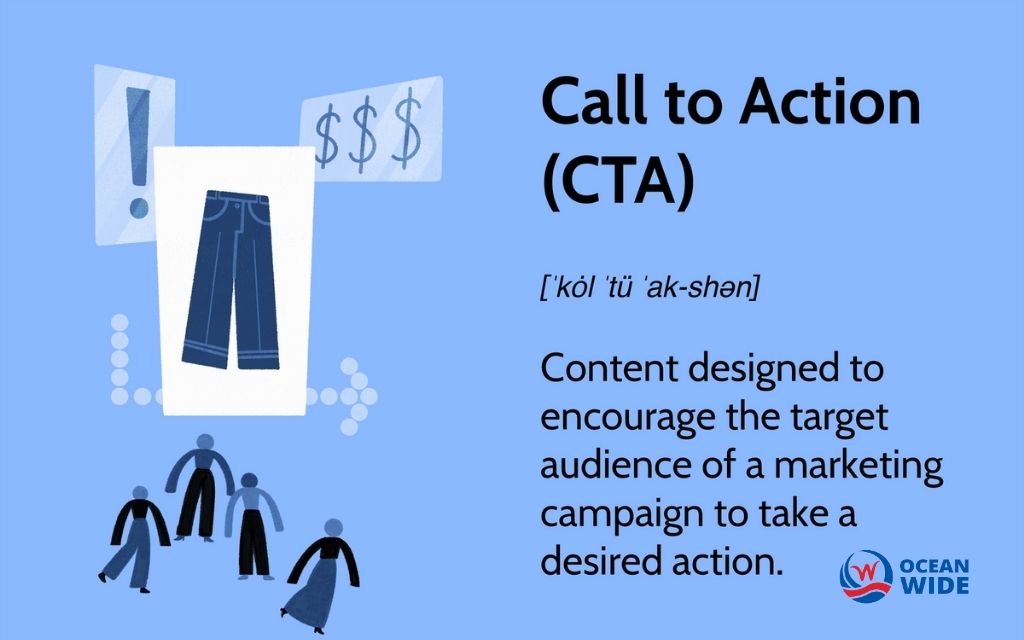
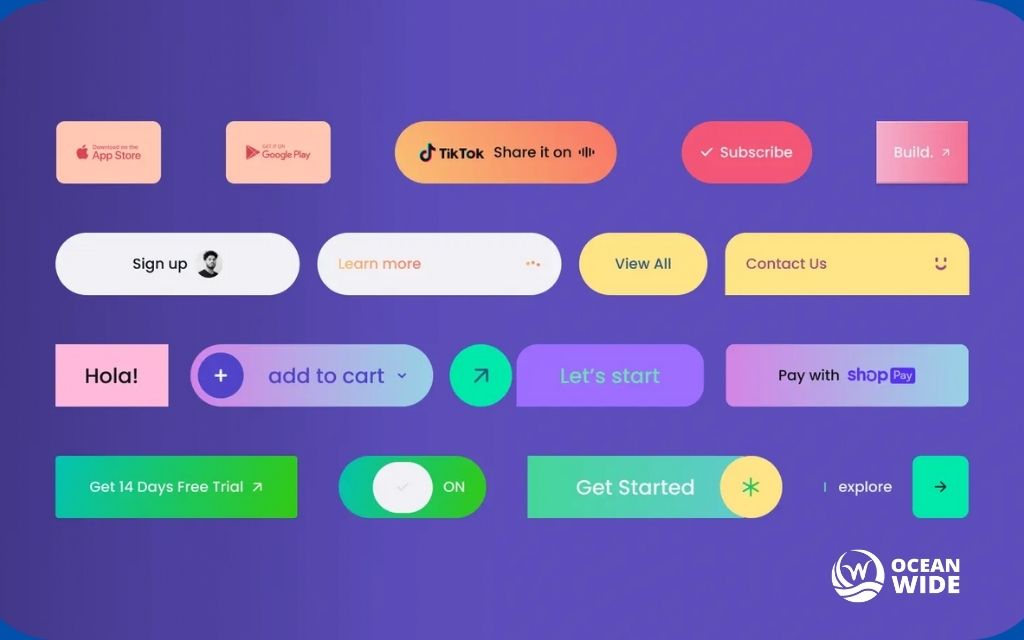
A social media CTA is a direct, action-driven prompt guiding the next step. It can be as simple as “Call us,” “Visit our site,” or “DM for pricing.” These prompts appear in different forms across platforms: text in captions, clickable buttons (Book Now, Call Now), link stickers in Stories, or comment prompts like “Drop a like if you agree.”
The core function of a call to action in social media is to move someone from passive scrolling to active engagement. Without a CTA, even the most compelling content can leave users uncertain about what to do next.
How CTAs turn followers into customers
CTAs create a bridge between content and conversion. When you post about your service or product without a clear next step, followers may appreciate the content but never take action. A well-placed CTA increases click-through rate, drives traffic to your landing page, and converts interest into measurable outcomes like calls, bookings, or purchases.
Consider a Denver yoga studio that posts “New class this week.” The post might get likes, but few bookings. Change it to “Tap to reserve your spot for Wednesday’s 6 PM class,” and bookings increase because the action is specific, easy, and immediate.
CTAs work because they reduce decision fatigue. Instead of asking followers to figure out the next step, you tell them exactly what to do.
Why CTAs are critical for Denver and Colorado small businesses
Local purchasing behavior in Denver and across Colorado leans heavily on mobile-first browsing and “near me” intent. When someone searches for coffee shops, plumbers, or boutiques on their phone, they want fast answers and quick actions. Social media CTAs that reference Denver neighborhoods (like “South Federal,” “Cap Hill,” or “Aurora”) or Colorado context (“before the next snow,” “perfect for hiking season”) feel more relevant and drive higher conversion.
The Ocean Wide has worked with Denver businesses to connect social CTAs directly to real-world visits, calls, and leads. Localized CTAs paired with optimized landing pages create a seamless path from scroll to sale.
Types of social media CTAs every small business should know
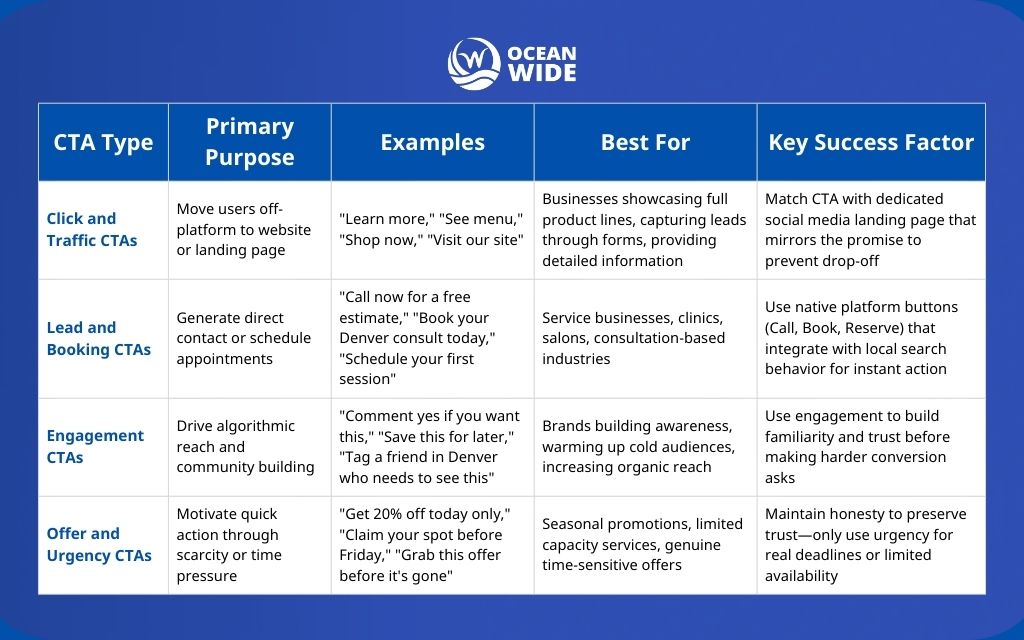
Understanding the different types of CTAs helps you match the right prompt to your goal. Each type serves a specific function in your social media funnel.
Click and traffic CTAs (link clicks, website visits)
These CTAs focus on moving users off the platform to your website or landing page. Examples include “Learn more,” “See menu,” “Shop now,” or “Visit our site.” The goal is to drive traffic where you can provide deeper information, showcase your full product line, or capture leads through a form.
The key to success with traffic CTAs is matching the CTA with a dedicated social media landing page. Sending Instagram followers to your homepage can cause drop-off if they have to hunt for the offer or product mentioned in your post. A focused landing page that mirrors the promise in your CTA keeps momentum and improves conversion rate.
Lead and booking CTAs (calls, forms, appointments)
Lead-focused CTAs aim to generate direct contact or schedule appointments. Examples include “Call now for a free estimate,” “Book your Denver consult today,” or “Schedule your first session.” These CTAs work well for service businesses, clinics, salons, and any industry where the sale happens through conversation or consultation.
Facebook and Instagram offer native buttons like Call, Book, and Reserve that integrate with local search behavior. When someone taps these buttons, the action happens instantly (dialing your number, opening a booking form). Google Business Profile CTAs work the same way, reinforcing your call to action in social media across search and social channels.
Engagement CTAs (comments, saves, shares)
Engagement CTAs drive algorithmic reach and community building rather than immediate sales. Examples include “Comment yes if you want this,” “Save this for later,” or “Tag a friend in Denver who needs to see this.” These prompts encourage interaction that signals value to the platform, increasing the likelihood that your content reaches more people.
Engagement CTAs warm up audiences before harder conversion asks. A user who saves your post about organization tips is more likely to book your home organizing service later. Engagement builds familiarity and trust over time.
Offer and urgency CTAs (discounts, deadlines, limited spots)
These CTAs use scarcity or time pressure to motivate action. Examples include “Get 20% off today only,” “Claim your spot before Friday,” or “Grab this offer before it’s gone.” Urgency CTAs tap into fear of missing out and can drive quick decisions.
Urgency must be honest to maintain trust and long-term brand equity. If you run “limited time” offers every week, followers stop believing the urgency. Use these CTAs for genuine promotions, seasonal offers, or when you truly have limited capacity (like appointment slots or event tickets).
Platform-specific CTA social media strategies
Each social platform has unique user behavior, interface features, and content formats. Your CTA social media strategy should adapt to these differences.
| Platform | Best for | Key CTA features | Recommended CTA types | Examples |
| Local service businesses, Denver neighborhoods, Colorado communities | Page Call-to-Action buttons (Call Now, Send Message, Learn More), Boosted posts with local offers | Conversational CTAs, Questions, Polls, Local offers | “What’s your biggest challenge with home repairs?” or “10% off gutter cleaning in Lakewood this month” | |
| Visual storytelling, Retail, Restaurants, Fitness, Beauty, Lifestyle brands | Link in bio, Story link stickers, Profile buttons (Book, Reserve, Order), Text overlays on Reels | Early caption CTAs, Save prompts, DM triggers, Swipe actions | “Save this for later,” “DM us ‘MENU’ for today’s specials,” “Tap the link in our bio to book your Denver detailing” | |
| TikTok | Fast-spreading content, Quick conversions, Engagement-driven brands | Verbal CTAs in video, Text overlays, Link in bio, Participation prompts | Participation CTAs (duets, stitches), Comment invitations, Direct action prompts | “Tap the link in our bio to order pickup from our South Broadway location,” “Drop your questions in the comments” |
| B2B companies, Consultants, Professional services in Colorado | Carousel posts, Educational articles, Thought leadership content, DM invitations | Soft CTAs, Download offers, Consultation bookings, Discussion starters | “Book a consult,” “Download the checklist,” “Message us to discuss your project,” “Want help implementing this? Reach out for a strategy session” |
Key takeaways for platform selection:
- Facebook works best when you invite conversation rather than pushing sales. The algorithm rewards engagement, so questions and polls that invite comments generate more reach than direct “Buy now” posts.
- Instagram requires visual appeal and repetition. Place your CTA early in the caption and reinforce it with text overlay on images or Reels. High engagement rates on Reels and Stories make them ideal for Denver small businesses.
- TikTok converts views into customers when you state the CTA verbally and visually. Participation CTAs that invite duets or comments drive algorithmic reach while warming audiences for future conversion asks.
- LinkedIn rewards educational content and soft CTAs. Focus on relationship building through thought leadership, then close with consultation offers or resource downloads that demonstrate your E-E-A-T.
How to write high-converting CTAs social media for Denver small businesses
Writing effective CTAs involves more than picking a verb and adding “now.” The best CTAs follow a formula that aligns with user intent and removes friction.
The 4-part formula for effective social media CTAs
A strong CTA typically includes four elements: audience, action, benefit, and urgency (optional). Here’s how it works:
Audience: Who are you talking to? (“Denver homeowners,” “Colorado runners,” “Startups in RiNo”)
Action: What do you want them to do? (“Book,” “Call,” “Download,” “DM”)
Benefit: Why should they act? (“Free roof check,” “Get your free guide,” “10% off your first order”)
Urgency (optional): When should they act? (“Before the next snow,” “This week only,” “Limited spots”)
Examples in action:
- “Denver homeowners, book your free roof check before the next snow.”
- “Colorado runners, get your free injury guide today.”
- “Startups in RiNo, schedule your brand consult this week.”
Each element guides the user toward a decision. The audience filter helps the right people pay attention. The action removes confusion. The benefit answers “What’s in it for me?” Urgency creates momentum.
Adding local context without sounding spammy
Localization makes your CTA social media feel relevant to Denver and Colorado audiences, but overusing “Denver” can sound forced. Use city names, neighborhoods, and local culture cues naturally.
- Generic CTA: “Book your free consult today.”
- Localized CTA: “Book your free Denver consult before the first snow.”
- Better localized CTA: “Cap Hill homeowners, book your free insulation check this fall.”
Mention neighborhoods (South Federal, Cherry Creek, Aurora), local events (Rockies games, First Friday art walks), or Colorado seasonality (ski season, wildflower blooms, snow prep). These details signal that you understand the local market without repeating “Denver” in every sentence.
Matching CTA strength to the buyer journey
Not every follower is ready to buy or book immediately. Your CTA should match where they are in the journey.
- Cold audiences (new followers, broad reach) respond better to softer CTAs like “Save this post,” “Follow for more tips,” or “Comment your biggest challenge.” These actions build familiarity without asking for a big commitment.
- Warm audiences (engaged followers, people who have interacted before) are ready for mid-funnel CTAs like “Learn more,” “See our menu,” or “Read the full guide.” They want more information before deciding.
- Hot audiences (people who visited your site, messaged you, or showed buying intent) need direct CTAs like “Book now,” “Call today,” or “Order online.” They’re ready to convert.
A simple way to apply this: use engagement CTAs in awareness posts, traffic CTAs in educational content, and booking CTAs in promotional posts or retargeting ads.
Testing, measuring, and optimizing CTA social media
Even the best CTA can underperform if it’s not tested and refined. Tracking performance and iterating based on data separates effective CTAs from guesswork.
Metrics that matter for social media CTAs
The metrics you track depend on your CTA goal, but these are the most common indicators of success:
- Click-through rate (CTR): Percentage of people who clicked your link or button after seeing the post. Higher CTR means your CTA and content are compelling.
- Conversion rate: Percentage of clicks that resulted in the desired action (call, booking, purchase). This shows whether your landing page or offer matches the promise in your CTA.
- Cost per result (for ads): How much you spent to generate one click, call, or booking. Lower cost means better efficiency.
- Engagement rate: Saves, comments, and shares signal value even if they don’t immediately convert. High engagement often leads to better reach and future conversions.
Most platforms provide these metrics in their native insights dashboards (Facebook Insights, Instagram Analytics, TikTok Analytics). You can also add UTM tags to links to track traffic and conversions in Google Analytics, giving you a complete view of how social CTAs contribute to business goals.
A/B testing social media CTAs on a budget
A/B testing means comparing two versions of a post to see which CTA performs better. Even small businesses can run simple tests without big ad budgets.
Test one element at a time. If you change the CTA text, the image, and the targeting all at once, you won’t know what caused the difference in performance. Start with CTA wording. For example, run a Denver home services ad with two versions:
Version A: “Call now for a free estimate.”
Version B: “Get your free Denver estimate today.”
Let each version run for a few days, check the CTR and conversion rate, then use the winner going forward. Over time, these small improvements add up to significantly better results.
Other elements to test include CTA placement (first line of caption vs last line), button type (Call vs Message), and creative format (image vs Reel). Testing reveals what resonates with your specific audience in Colorado.
Iterating CTAs with AI and content insights
AI tools can suggest CTA variations and content ideas, but final decisions should always be grounded in real audience behavior and data. Use AI to generate options, then pick the one that aligns with your brand voice and past performance patterns.
Documenting what works for your Denver audience also helps your content show up in AI Overviews and search snippets. When you publish blog posts or guides that explain your CTA strategy with real examples, search engines recognize the depth and relevance, boosting your visibility for queries like “how to write a call to action in social media.”
Real-world micro examples from Denver and Colorado
Seeing CTAs in context makes them easier to adapt for your own business. Here are examples across common Denver industries.
Restaurant and café CTA examples
Denver’s food scene is competitive. CTAs that focus on reservations, ordering, and special offers stand out on Instagram and Facebook.
- Instagram Story CTA: “Craving pho on a snowy Denver day? Tap to order pickup on Federal now.”
- Facebook post CTA: “New brunch menu drops Saturday. Reserve your table for 10 AM before we fill up.”
- TikTok video CTA: “Watch us make our famous green chile breakfast burrito. DM ‘BURRITO’ for the full menu.”
These CTAs work because they create immediate desire, reference local context (snow, Federal Boulevard), and make the next step obvious.
Home services and trades CTA examples
Home services (plumbers, roofers, landscapers, cleaners) need lead-driven CTAs focused on calls and quote requests.
- Facebook ad CTA: “Denver homeowners, send us a DM with ‘LEAK’ and we’ll schedule a same-day inspection.”
- Instagram post CTA: “Roof looking rough after last week’s hail? Call (720) 334-0899 for a free damage assessment in Littleton.”
- Google Business Profile CTA button: “Get Quote” (linked directly to contact form)
These CTAs remove friction by offering immediate value (same-day service, free assessment) and using direct channels (phone, DM, form).
Fitness, wellness, and clinics CTA examples
Fitness studios, yoga instructors, clinics, and wellness providers thrive on trial offers, intro sessions, and membership CTAs.
- Instagram Reel CTA: “Colorado runners, book your free injury-prevention evaluation this week. Only 10 slots available.”
- Facebook event post CTA: “Join our free sunrise yoga class at Sloan’s Lake Saturday. Tap ‘Going’ to reserve your spot.”
- LinkedIn post CTA (for corporate wellness): “Want healthier, happier teams? Message us to discuss on-site wellness programs for Denver companies.”
These CTAs create urgency with limited availability and appeal directly to the audience’s identity (runners, teams, yoga enthusiasts).
B2B and local tech startup CTA examples
B2B services and tech startups in Denver need LinkedIn and website-driven CTAs focused on downloads, consultations, and case studies.
- LinkedIn article CTA: “Download our free checklist for launching a Colorado startup.”
- Instagram carousel CTA: “Swipe to see how we helped a Denver SaaS company double their trial signups. Book a discovery call to explore what we can do for you.”
- Twitter (X) post CTA: “Struggling with product-market fit in the Front Range? DM us for a free 20-minute strategy session.”
B2B CTAs emphasize proof, expertise, and low-risk entry points (free guide, short call). Demonstrating E-E-A-T through case studies and specific results builds trust before asking for business.
Making CTAs work with your website, landing pages, and local SEO
A strong CTA is only as effective as the experience that follows the click. If your landing page is slow, confusing, or generic, conversions will drop no matter how good your CTA is.
Why your CTA is only as strong as its landing page
When someone clicks “Book your Denver detailing,” they expect to land on a page about detailing services in Denver. If they arrive at a generic homepage with no mention of the offer, they leave. The landing page must match the promise in the CTA.
Speed matters too. Mobile users in Colorado abandon pages that take more than three seconds to load. Optimize images, reduce scripts, and use fast hosting to keep bounce rates low.
Social media landing pages built to match your CTAs
Social media landing pages are single-focus pages designed for traffic from a specific CTA or campaign. They remove distractions and guide visitors toward one action: booking, calling, or filling out a form.
For example, if your Instagram CTA says “Get 20% off gutter cleaning this week,” the landing page should show the offer front and center with a simple form or phone number. No navigation menu clutter, no unrelated services. Just the offer and the conversion path.
The Ocean Wide builds conversion-focused landing pages for Denver businesses that align with social CTAs. Each page is designed to load fast, communicate clearly, and convert mobile traffic into leads.
Local SEO, Google Business Profile, and social CTAs
Your Google Business Profile acts as a bridge between search and social. CTAs on your profile (Call, Get Directions, Visit Website) should match the language and offers you use on social media. Consistency reinforces trust and makes it easier for customers to take action.
For example, if your Facebook posts say “Call for a free quote,” your Google Business Profile button should also say “Get Quote.” If your Instagram bio says “Book online,” your website should have a clear booking link on the homepage.
Local SEO and social media work together. When someone searches “Denver HVAC repair” and finds your Google profile, they might check your Instagram or Facebook for reviews and recent work. If your CTAs are consistent and your landing pages deliver on the promise, conversion rates improve across all channels.
How to optimize CTA-focused content for AI Overviews and AI search
Search is changing. AI Overviews, AI search engines, and voice assistants prioritize content that is clear, structured, and answers specific questions. Optimizing for AI means writing in a way that machines can parse and humans can understand.
Structuring content for snippets and AIO
AI Overviews pull information from pages that use clear definitions, lists, and Q&A sections. To increase your chances of appearing in these results, structure your content with questions as headings and direct answers in the first sentence.
For example, instead of writing “Understanding what makes a social media CTA effective requires looking at several factors,” write “A social media CTA works when it tells users exactly what to do, matches their intent, and removes friction.”
Use FAQ sections with schema markup (FAQPage schema) to signal to search engines that your page answers common questions. This boosts visibility for queries like “how to write a call to action in social media” or “best social media CTA for small business.”
Using semantic and long-tail queries around social media CTAs
People search in different ways. Some type “CTA social media,” while others ask “how do I write a call to action on Instagram” or “social media CTA examples for restaurants in Denver.” Weaving natural questions and variations into your headings and content helps you rank for more searches.
Focus on topic depth, not keyword stuffing. Cover the concept thoroughly with real examples, templates, and explanations. Search engines and AI tools reward comprehensive content that satisfies user intent.
Demonstrating E-E-A-T in your social CTA content
E-E-A-T (experience, expertise, authoritativeness, trustworthiness) is critical for YMYL (Your Money or Your Life) topics and increasingly important for all content. Show E-E-A-T by including real examples, client results, and clear authorship.
For example, when explaining CTA strategies, mention how you helped a Denver bakery increase online orders by 40% with a simple Instagram CTA change. Link to case studies or testimonials when possible. Identify the author and their role (like “Written by the marketing team at The Ocean Wide, a Denver agency with 10 years of experience”).
Trustworthy content answers questions accurately, cites sources when needed, and avoids making promises it can’t keep. If you say a CTA will “double your sales,” provide evidence or context. If you can’t, choose language that reflects realistic outcomes.
When to DIY your CTAs and when to partner with a Denver agency
Not every business needs an agency to write CTAs. But some signs indicate you’re ready for expert help.
CTA quick wins you can implement today
Start with small, actionable changes. Pick one platform (Instagram, Facebook, LinkedIn) and one goal (more calls, more bookings, more traffic). Add clear CTAs to your next 10 posts. Test a local variant (mention Denver, Colorado, or a neighborhood). Review which posts get the most clicks, calls, or engagement.
Track basic metrics in your platform’s native insights. Look for patterns. Did posts with “Book now” perform better than “Learn more”? Did mentioning a neighborhood increase engagement? Use what you learn to refine your approach.
You don’t need expensive tools or a big budget to improve CTA performance. Consistency, clarity, and testing go a long way.
Signs you’re ready for expert help
If you’re getting decent reach but low clicks, high clicks but low leads, or inconsistent brand voice across CTAs and landing pages, it may be time to bring in an agency. Other indicators include:
You don’t have time to test and optimize regularly.
Your landing pages don’t match your CTAs, causing drop-off.
You’re running ads but not seeing ROI.
You want to scale your social media efforts without scaling your team.
An agency like The Ocean Wide can audit your full funnel from CTA wording to landing page performance and local SEO alignment. We map out where users drop off, identify what’s working, and build systems that convert consistently.
FAQs CTA social media questions small businesses ask
What is a good call to action for social media?
A good CTA is specific, action-oriented, and benefit-driven, such as “Book your free Denver consult” instead of “Contact us.” It tells users exactly what to do and why they should do it. The Ocean Wide helps Denver businesses craft CTAs that match their audience and platform.
How often should I include a CTA in my social posts?
Most posts should include a CTA, even if it’s a soft one like “Save this for later” or “Tell us in the comments.” Training your audience to take action builds momentum. If you’re unsure how to balance sales and engagement CTAs, The Ocean Wide can design a content calendar tailored to your goals.
Do CTAs work better in the caption or the image/video?
CTAs perform best when repeated: once in the creative (image or video text) and once in the caption or overlay. Users skim differently, so repetition ensures they see the CTA. If you need help optimizing creative formats and CTA placement, call (720) 334-0899 to discuss your strategy.
What’s the difference between engagement CTAs and sales CTAs?
Engagement CTAs aim for comments, saves, or shares, while sales CTAs push for immediate revenue actions like calls, bookings, or orders. Both are important at different stages. The Ocean Wide builds social funnels that use engagement CTAs to warm audiences before asking for sales.
How do I know if my CTAs are working?
Track metrics like CTR, link clicks, calls, bookings, and form submissions from social. Compare posts with different CTAs over time to see what drives real results. If tracking feels overwhelming, The Ocean Wide can set up simple systems that show which CTAs lead to revenue.
Conclusion
The Ocean Wide blends branding, web design, landing pages, SEO, and social marketing so your CTAs align from post to page to purchase. We understand Denver and Colorado markets, helping small businesses and startups turn local attention into measurable growth.
Our team has worked with restaurants, home services, fitness studios, retail shops, and professional services across the Front Range. We know what CTAs resonate with Denver audiences and how to build landing experiences that convert mobile traffic.
We can audit your current CTAs and landing experience, get you tailored CTA templates for your industry and platform mix, and build or refine social media landing pages aligned with your campaigns.
Ready to make every “like” count? The Ocean Wide team can help you design social media CTAs, landing pages, and campaigns that fit how Denver customers actually browse and buy. Visit us at 1007 S Federal Blvd, Denver, CO 80219, email [email protected], or call (720) 334-0899 any time to talk about crafting CTA social media that truly converts for your Colorado small business.