Skip to content



B2B market research shows how business buyers choose vendors, so your positioning, pricing, and marketing rest on evidence. We wrote this guide for small and mid-size companies that sell to other businesses. You get the 8 research types, the core methods, sample-size rules, a 7-step process, and the way we turn findings into brand, website, SEO, and social campaigns.
What is B2B market research?
B2B market research is the process of collecting and analyzing data about business buyers, industries, and competitors to guide decisions on positioning, pricing, products, and marketing. It studies the people who evaluate, influence, and approve purchases inside a company.
That buyer group goes beyond your current customers. A complete study covers 4 audiences: active clients, lost prospects, internal influencers such as IT leads, finance managers, and procurement officers, and competitors whose offers shape buyer expectations.
Many teams use “B2B research” and “B2B customer research” as shorthand for the same discipline. The scope matters more than the label: you study organizations, and the humans who speak for them.
Market research vs. marketing research, market analysis, and customer research
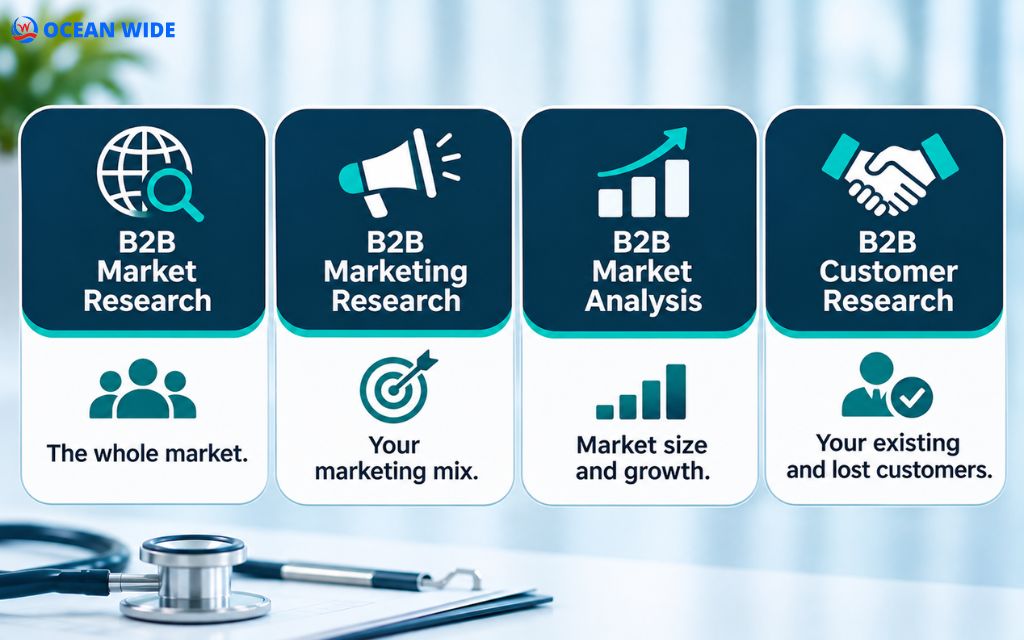
These 4 terms overlap, but each one answers a different question. The table separates them so you scope your project before you spend money.
| Term | What it studies | Example question |
| B2B market research | The whole market: buyers, segments, size, and competitors | Is there demand for a managed IT plan for 20-person law firms? |
| B2B marketing research | The performance of your marketing mix | Which headline gets more demo requests from operations managers? |
| B2B market analysis | Market size, growth, and structure, often from secondary data | How many print buyers operate in our metro area? |
| B2B customer research | Your existing and lost customers | Why did 3 clients leave us after the first contract? |
How B2B market research differs from B2C
B2B research differs from consumer research in 5 ways: the respondents, the number of decision makers, the sample size, the incentive cost, and the timeline. Each difference changes how you plan a study.
| Factor | B2B research | B2C research |
| Who answers | Executives, managers, evaluators, and end users | Individual shoppers |
| People per decision | A buying group of several roles | One person or one household |
| Typical sample (QuestionPro) | 20 to 500 respondents | 1,000 to 10,000+ respondents |
| Recruiting | Hard, with strict screening | Easier, with large panels |
| Typical timeline (QuestionPro) | 4 to 12 weeks | 1 to 4 weeks |
Buying groups: what Gartner and Forrester found
Gartner has reported that a typical buying group for a complex B2B solution includes 6 to 10 decision makers. Forrester’s “The State of Business Buying, 2026” counted 13 internal stakeholders and 9 external influencers in a typical purchase.
The gap comes from definitions. Gartner counts decision makers, while Forrester also counts people who influence the choice. For your research, the lesson is the same: interview more than one role per account, or you will hear only one side of the decision.
Smaller populations change the research math
A B2B market can hold a few hundred qualified buyers, not millions. A small population makes every respondent valuable and every bad respondent costly. It also explains why senior professionals expect larger incentives for their time.

What decisions can B2B market research support?
B2B market research supports any decision where a wrong guess costs months of sales effort. These 6 decisions benefit the most:
- Positioning and messaging: Research shows which problems buyers rank first and which words they use to describe them.
- Targeting and ICP: Interviews reveal which company size, industry, and role buy fastest and stay longest.
- Pricing and packaging: Buyers tell you which budget line pays for your service and where the price ceiling sits.
- New offers: Concept tests confirm demand before you build a product or service tier.
- Market entry: Market sizing tells you whether a new industry or region holds enough buyers.
- Win-loss: Lost-deal interviews expose the real reasons prospects chose a competitor.
When we start a website or SEO project at The Ocean Wide, we ask clients for the last 5 deals they won and the last 5 they lost. Those 10 stories often say more about positioning than a 40-question survey.

8 types of B2B market research
The 8 types of B2B market research are buyer persona, buyer journey, competitive, market sizing, brand, pricing, win-loss, and go-to-market research. Each type answers one decision, as the table shows.
| Type | Decision it informs | Common method |
| Buyer persona and ICP research | Who to target and how to describe them | In-depth interviews, CRM analysis |
| Buyer journey research | Where buyers search, compare, and decide | Interviews, website analytics |
| Competitive landscape analysis | How to differentiate your offer | Desk research, review mining |
| Market sizing (TAM, SAM, SOM) | Whether a market is worth entering | Government data, industry reports |
| Brand research | How buyers perceive and recall you | Awareness surveys, interviews |
| Pricing research | What buyers will pay and why | Budget interviews, Van Westendorp, conjoint |
| Win-loss and satisfaction research | Why you win, lose, or retain accounts | Post-decision interviews, NPS or CSAT |
| Go-to-market research | Which segment, channel, and message to launch with | Mixed methods |
Go-to-market and B2B technology research
B2B go-to-market research combines several types into one launch plan: segment, channel, message, and price. B2B technology market research applies the same logic to software and IT services, where buyers add security, integration, and IT approval steps to the decision.
Industry research works the same way for manufacturers, law firms, or logistics providers. You adapt the questions to the regulations, vocabulary, and buying rules of that sector.

B2B market research methods
B2B market research methods fall into 2 pairs: primary versus secondary research, and qualitative versus quantitative research. Most strong studies mix at least one method from each pair.
Primary vs. secondary research
Primary research is data you collect yourself from buyers, through interviews, surveys, focus groups, or advisory boards. Secondary research is data someone else already published, such as analyst reports, government statistics, competitor websites, and review sites.
Start with secondary research. It is cheap, fast, and sharpens the questions you later ask in primary research.
Qualitative vs. quantitative research
Qualitative research explains why buyers act, through open conversations with a small group. Quantitative research measures how many buyers act, through structured surveys with a larger sample. Interviews find the themes; surveys test how common those themes are.
The table below compares the 7 methods we see used most by small B2B teams.
| Method | Best for | Effort | Cost level |
| In-depth interviews | Motives, objections, buyer language | Medium | Low to medium |
| Online surveys | Measuring how common a need is | Medium | Medium to high |
| Focus groups or advisory boards | Testing concepts with peers | High | Medium |
| Desk research | Market size, trends, regulations | Low | Low |
| Competitor and review mining | Gaps in rival offers | Low | Low |
| CRM and sales data | Win, loss, and churn patterns | Low | Low |
| Search data | Real demand and buyer questions | Low | Low |

Search data as market research
Search data is the most overlooked B2B research source, because buyers type their problems into Google before they call a vendor. Three free tools give you this demand data:
- Google Search Console reports the queries, clicks, impressions, and average position for your own site.
- Google Keyword Planner estimates average monthly searches for a term inside a Google Ads account.
- Google Trends shows relative interest on a 0 to 100 scale across time and regions.
We open every SEO engagement with this step. The People Also Ask box adds the exact questions buyers ask, which often become FAQ content and sales talking points.
Free public data: Census County Business Patterns
The U.S. Census Bureau’s County Business Patterns counts business establishments with paid employees by NAICS industry code, county, and ZIP code. The Bureau releases it every year, about 18 months after the reference year.
A Denver print shop could use it to count law firms, dental practices, and property managers in Denver County before it builds a B2B outreach list. Businesses without employees fall outside this dataset, so pair it with the Census Nonemployer Statistics for solo operators.

How to do B2B market research in 7 steps
To do B2B market research, follow 7 steps that move from one decision to one action. We use the same sequence when we prepare a positioning brief for a client.
1. Name the decision: Write one sentence that states what you will decide with the results, such as “Which of 2 industries should we target in 2027?”
2. Write objectives and hypotheses: List 3 to 5 questions and your current best guess for each, so the data can prove you wrong.
3. Define who to study: Specify industry, company size, job title, and decision role for every respondent group.
4. Choose your methods: Match the method to the question, and begin with secondary data and interviews.
5. Recruit and screen: Find respondents, confirm their role, and offer a fair incentive.
6. Collect and analyze: Record interviews, tag repeated themes, and compare segments before totals.
7. Share and act. Summarize findings on one page (8.5 x 11 inches, or 21.6 x 27.9 cm) with 3 recommended actions and an owner for each.
Sample B2B research questions by goal
Good questions ask about past behavior, not future intent. Use these examples as a starting point:
| Goal | Sample question |
| Problem | What triggered your search for a new provider last time? |
| Buying process | Who else joined the decision, and what did each person need to see? |
| Competitors | Which other vendors did you consider, and why did they fall short? |
| Pricing | Which budget line paid for this, and who approved it? |
| Messaging | How would you describe our service to a colleague in one sentence? |

How many participants do you need?
Most B2B interview studies reach saturation at about 12 interviews per segment, and most surveys need about 385 responses for a ±5-point margin of error. Small B2B populations need fewer survey responses.
Interviews: the 12-interview rule
In their 2006 study, Greg Guest, Arwen Bunce, and Laura Johnson found that 73% of codes appeared in the first 6 interviews and 92% within the first 12. Their sample was homogeneous, so plan 10 to 12 interviews for each distinct segment, such as owners versus IT managers.
Surveys: margin of error and small markets
A large population needs about 385 random responses for a ±5-point margin at 95% confidence. A small population needs fewer: a market of 500 firms needs about 218 responses for the same precision, after the finite population correction.

Finding respondents and protecting data quality
Recruiting the right respondents is the hardest part of B2B research. Ipsos notes that B2B panels cost less but contain more unqualified respondents, and that fraud can distort results without anyone noticing.
Where to find respondents
Use 5 sources, in this order: current customers, lost prospects from your CRM, LinkedIn connections in your target roles, industry associations, and paid B2B panels or expert networks. Ask a neutral third party to run lost-deal interviews, because buyers speak more freely to someone outside your sales team.
Incentives, screeners, and trap questions
Pay respondents in line with their time. Ipsos gives the example of a CEO billing $400 an hour, who will not finish a 20-minute survey for a $5 reward. Add screener questions on role and company size, and include a fake company name in a brand list to catch respondents who invent answers.

A lean B2B research plan for small businesses
A small business can run useful B2B market research in 4 weeks with internal time and free tools. This plan fits a team of 1 to 3 people:
| Week | Activity | Output |
| Week 1 | Write the decision, pull CRM data, review Search Console queries, and count target firms in Census data | A 1-page research brief |
| Week 2 | Interview 6 customers and 3 lost prospects for 30 minutes each | Recorded calls and notes |
| Week 3 | Mine 3 competitor websites and 20 reviews; run a 5-question survey to your list | Competitor grid and survey results |
| Week 4 | Tag themes, compare segments, and pick 3 actions | Findings summary and action plan |
A plan this size will not support national market-share claims. It will show you what your best buyers value, in their own words.

Turning research into positioning, website messaging, SEO, and ads
Research pays off only when it changes what buyers see. Apply findings to 4 assets, in this order: brand positioning, website copy, SEO priorities, and paid ads.
Positioning and brand messaging
Pull the 3 problems buyers mention most and the exact phrases they use. Those phrases become your value proposition, tagline, and sales talking points. Keep the buyer’s wording instead of polishing it into industry jargon, because buyers trust words that sound like their own.
Website copy and UX
Turn every repeated objection into a page section or an FAQ answer. If buyers worry about onboarding time, show the timeline on the service page. Our website design team maps these objections to page layout before writing a headline.

SEO keyword and content priorities
Match buyer questions from interviews with search queries from Keyword Planner and Search Console. Topics that appear in both sources go to the top of your content plan, because they show real demand and real pain.
Ad copy and message testing
Paid search and LinkedIn ads let you test 2 or 3 messages against each other in 2 to 4 weeks. Our digital advertising team uses the headline with the higher conversion rate to confirm the positioning before a full campaign.

Put your research to work with our Social Marketing Service
Our Social Marketing Service turns B2B research findings into posts, campaigns, and conversations on the platforms where decision makers spend time. Social channels also feed new research back to you.
- Social listening: We track comments, competitor posts, and industry hashtags to spot recurring buyer complaints.
- LinkedIn polls: We run short polls to test a message or a pain point with your target roles.
- Content distribution: We publish research-based content, such as checklists, quotes, and short videos, that answers the questions buyers asked.
- Performance reports: We report which messages earn clicks and inquiries, so you refine your positioning with each cycle.
Social marketing works best after research, because every post then speaks to a verified buyer problem. Learn more about our social marketing packages.

DIY vs. hiring a B2B market research company
Do your own research when the audience is your existing customers and the decision is reversible. Hire a B2B market research company when you need hard-to-reach executives, a statistically valid survey, or neutral interviews about competitors.
QuestionPro, citing Infomineo estimates, lists $150 to $500 per completed B2B interview and $15,000 to $50,000 for an online survey of 200 to 500 respondents. Treat these figures as a planning range, not a quote. Check 4 things before you sign with a firm:
- B2B experience in your industry and with your target job titles.
- Sample sources and how the firm verifies respondent identity.
- Sample deliverables that show recommendations, not only charts.
- Data ownership terms for transcripts, recordings, and raw data.

Common B2B market research mistakes
Most failed B2B studies share the same 6 mistakes:
- Starting without a decision: A study without a decision produces interesting facts and no action.
- Asking leading questions: Questions such as “Would you value faster support?” invite a yes and hide real priorities.
- Interviewing one role per account: A single contact cannot speak for a buying group of several people.
- Trusting unscreened panels: Unverified respondents add noise that looks like data.
- Reporting totals only: Averages hide the gap between segments, such as owners versus managers.
- Filing the report: Findings that never reach copy, pricing, or sales scripts waste the budget.

Can AI do B2B market research?
AI speeds up B2B market research, but it does not replace conversations with real buyers. AI tools summarize desk research, draft survey questions, transcribe calls, and group interview themes in minutes.
AI falls short in 3 areas: it repeats published opinions, it cannot verify who a respondent is, and it invents plausible numbers when data is thin. Use AI for speed, and use human interviews for truth. Check every AI-generated statistic against its original source.

FAQs about B2B market research
What is B2B market research in simple terms?
B2B market research is the study of how businesses choose and buy products or services. It helps you decide who to target, what to say, and how to price.
What are the main types of B2B market research?
The main types are buyer persona, buyer journey, competitive, market sizing, brand, pricing, win-loss, and go-to-market research. Each type informs one business decision.
How is B2B market research different from B2C?
B2B research studies a small group of professional buyers who decide as a team, while B2C research studies large groups of individual shoppers. B2B samples are smaller, incentives are higher, and timelines are longer.
Can a small business do B2B market research without an agency?
Yes. A small business can start with 8 to 12 customer interviews, CRM data, search data, and free Census statistics. Hire a firm when you need senior executives or a valid survey.
How much does B2B market research cost?
DIY research costs mostly staff time, while firm-led projects range from a few thousand to tens of thousands of dollars. QuestionPro, citing Infomineo, lists $15,000 to $50,000 for a 200- to 500-person B2B survey.
How many interviews do you need for B2B research?
Plan about 12 interviews per segment. Guest, Bunce, and Johnson found 92% of themes within the first 12 interviews in a homogeneous group.
How often should you repeat B2B market research?
Repeat research whenever the decision recurs or the market shifts, and at least once a year for customer and competitor studies. Win-loss interviews work best as an ongoing quarterly habit.
Can ChatGPT replace B2B market research?
No. ChatGPT can summarize published sources and draft questions, but it cannot interview your buyers or verify their answers. Use it to prepare research, not to replace it.