Skip to content

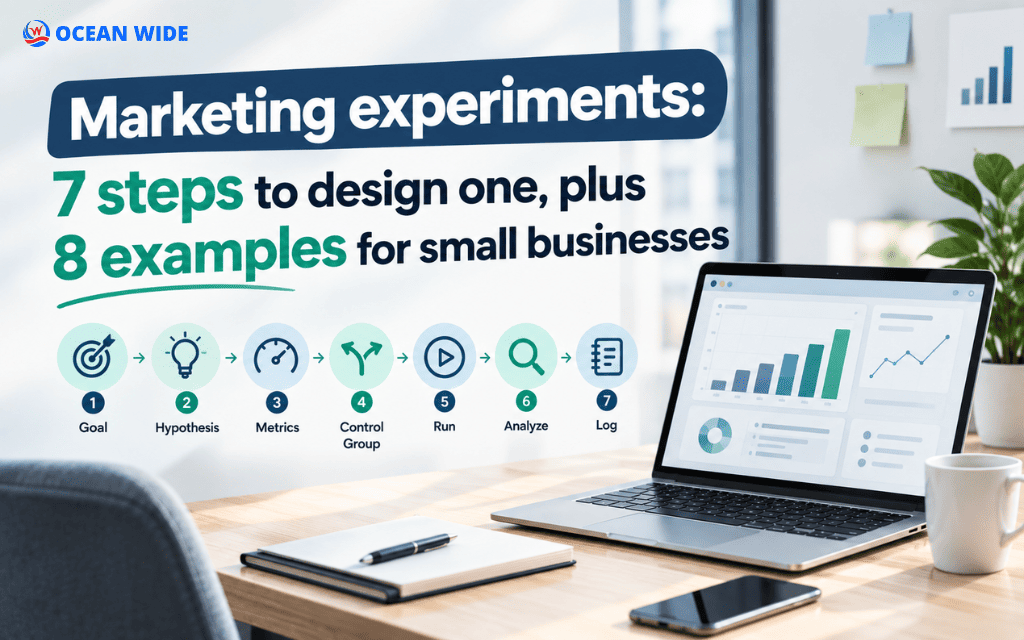
A marketing experiment shows you which ad, page, or offer moves revenue before you commit the full budget. This guide is for small business owners and lean marketing teams. You will learn to design a test in 7 steps, copy our template, and adapt 8 examples built for low-traffic businesses.
What is a marketing experiment?
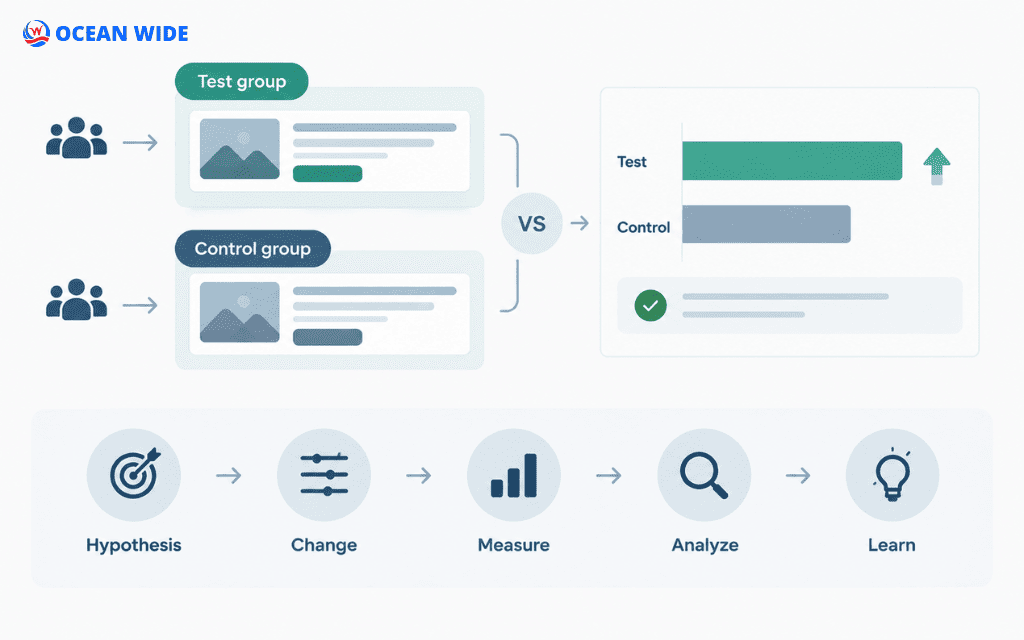
A marketing experiment is a controlled test that changes 1 marketing variable for a test group and compares the result against a control group. It proves cause and effect instead of guessing it.
Marketers also call it a marketing test, a split test, or experiment marketing. Each version follows the scientific method: form a hypothesis, change a condition, and measure the outcome.
The method has a long track record. In 2001, Harvard Business Review published “Boost Your Marketing ROI with Experimental Design” by Eric Almquist and Gordon Wyner. Today, ad platforms bring that rigor to a 5-person business.
The 3 parts of every marketing experiment
Every marketing experiment has 3 parts: subjects, conditions, and effects.
- Subjects are the people you test on, such as website visitors, email subscribers, or ad audiences. You split them into a control group and a test group.
- Conditions are the independent variable you change, such as a headline, an offer, or a bid strategy. One condition per test gives a clean read.
- Effects are the dependent variable you measure, such as calls, form fills, or booked jobs. Strong effects tie to revenue.
Marketing experiment vs. A/B test vs. test marketing vs. market research
These 4 terms overlap, but each answers a different question. The table below separates them.
| Term | What it is | Question it answers | Example |
| Marketing experiment | Any controlled test with a hypothesis and a control group | Does this change cause more leads? | Pausing ads in 3 ZIP codes to measure lift |
| A/B test | The simplest experiment: 2 versions, random split | Is version A or B better? | 2 email subject lines |
| Test marketing | Launching a product or service in a limited market first | Will this sell? | A new service offered in 1 suburb for 90 days |
| Market research | Surveys, interviews, and data analysis | What do customers want? | A post-purchase customer survey |
Experiment marketing also differs from experiential marketing. Experiential marketing creates live brand events. A marketing experiment measures the effect of a change.

Why small businesses should run marketing experiments
Small businesses should run marketing experiments because every wasted dollar weighs more on a $2,000 monthly budget than on a $2 million one. Experiments replace opinions with evidence.
Testing answers 3 practical questions:
- Which channel deserves the next dollar? A test shows whether search ads or social ads produce cheaper booked jobs.
- Which message makes the phone ring? A test shows whether customers respond to speed, price, or trust.
- Which tactic does nothing? Stopping a dead tactic frees the budget for a working one.
In our campaign work with Colorado restaurants, landscapers, and home care providers, we see a recurring pattern. Owners rarely lack ideas. They lack a way to tell which idea paid off, and a simple test log fixes that.
Bain & Company makes a similar point. Its 2023 analysis frames experimentation as a complement to traditional market research, and it notes that leading teams can prove or disprove a hypothesis within weeks.

Types of marketing experiments
There are 6 common types of marketing experiments. They differ in cost, sample size, and the strength of their cause-and-effect proof.
| Type | How it works | Best for | Strength of proof |
| A/B test (split test) | Random split between 2 versions | Pages, emails, and ads | High |
| Multivariate test | Tests several elements in combination | High-traffic pages | High, but needs large samples |
| Holdout test | Withholds marketing from a random group | Email and retargeting | High |
| Lift or incrementality study | Compares exposed users with eligible but unexposed users | Search, YouTube, and display ads | High |
| Geo or service-area test | Runs marketing in some areas and holds out others | Local ads and mailers | Medium to high |
| Pre-post test | Compares results before and after a change | Very low-traffic sites | Low, with no control group |
Pre-post tests carry the most risk. Seasonality, weather, or a competitor’s sale can explain the change, so add a control area or control period whenever you can.
Built-in tools you already have
You can run most digital marketing experiments inside platforms you already pay for. 4 tools cover the basics:
- Google Ads custom experiments test bid strategies, keyword match types, landing pages, and audiences. The experiment runs alongside the original campaign with a share of its traffic and budget.
- Google Ads Experiment Center groups experiments and lift studies in 1 dashboard, as of October 2026. Its controlled experiments split audiences by user or by geography.
- Meta Ads Manager A/B tests compare creative, audiences, or placements across Facebook and Instagram.
- Email platform A/B tests split a list, measure 2 subject lines, and send the winner to the rest.
Lift testing used to be an enterprise tool. According to Think with Google, Google Ads lowered the minimum cost of an incrementality experiment from as high as $100,000 to $5,000 in 2025. For social ads, our guide to A/B testing social media covers creative and audience splits in detail.

How to design a marketing experiment in 7 steps
To design a marketing experiment, follow 7 steps: pick a goal, write a hypothesis, choose metrics, set up the control, run the test, analyze results, and log the decision.
Step 1: Pick 1 goal and the bottleneck behind it
Start with 1 business goal, such as more booked estimates. Then find where prospects drop off. If 1,000 people visit your quote page and 8 submit the form, the form is the bottleneck, so test there first.
Step 2: Write a testable hypothesis
A testable hypothesis names the change, the expected effect, and the reason. Use this formula:
If we [change], then [metric] will [rise or fall] by [amount], because [customer insight].
For example: if we show “Free estimate in 24 hours” in the headline, then quote requests will rise 15%, because callers tell us speed matters most.

Step 3: Choose a primary metric and a guardrail metric
Pick 1 primary metric that decides the winner, such as cost per lead. Add 1 guardrail metric that must hold steady, such as lead quality. A cheaper lead that never books is a loss.
Step 4: Set a control group, randomize, and size the sample
The control group sees the current version, and the test group sees the change. Split them at random so time of day or device type cannot skew results.
A free sample size calculator estimates how many visitors you need. It asks for your current conversion rate and the smallest lift you care about. The smaller the lift you want to detect, the larger the sample you need.

Step 5: Run the test with the setup frozen
Set the start date, end date, and budget before launch. Run for at least 1 full business cycle, usually 2 to 4 weeks, so weekday and weekend behavior both count. Keep ads, bids, and pages frozen mid-test, because each edit adds a new variable.
Step 6: Analyze statistical and practical significance
Statistical significance tells you the result is unlikely to come from chance. Practical significance tells you the result is big enough to matter. A real 2% lift that saves $15 a month may not justify a rollout.
Check segments too. A variant can lose overall and still win on mobile.
Step 7: Decide, then log the learning
Every test ends with 1 of 3 decisions: scale, iterate, or stop. Record the result in an experiment log, even when the test fails. A failed test that protects next quarter’s budget still pays for itself.

Marketing experiment template you can copy
Use this 10-field template to plan every test on 1 page. The example column shows a hypothetical Denver landscaping company, not a client result.
| Field | What to write | Example (hypothetical) |
| Goal | The business outcome | More spring cleanup bookings |
| Bottleneck | Where prospects drop off | Quote page with 2% form completion |
| Hypothesis | If, then, because | If we cut the form from 9 fields to 4, completions will rise 30%, because mobile visitors quit long forms |
| Variable | The 1 change | Form length |
| Audience | Who sees each version | All quote-page visitors, split 50/50 |
| Primary metric | The metric that decides the winner | Form completion rate |
| Guardrail metric | The metric that must hold | Share of leads that book a site visit |
| Duration | Start, end, and minimum sample | 4 weeks, at least 100 form starts per version |
| Decision rule | What triggers a rollout | Roll out if completions rise 20% or more and bookings hold |
| Result and next test | Outcome and follow-up | Logged with date; next test: the headline |
Copy the table into a shared spreadsheet. One row per test becomes your experiment log.

How to run experiments with low traffic or a small budget
To run experiments with low traffic, test bigger changes, run tests longer, and measure signals closer to the click. 5 tactics make small samples useful:
- Test bold changes: A new offer or a new page layout can produce a 30% shift, while a button color change rarely shows anything on 300 visits a month.
- Extend the window: Run 4 to 8 weeks instead of 2 to collect enough conversions.
- Measure closer metrics: Form starts and click-to-call taps happen more often than signed contracts.
- Pool similar pages: Test 1 title tag pattern across 20 service pages instead of 1 page.
- Use service-area holdouts: Run a local ad or mailer in 3 ZIP codes and hold out 3 similar ZIP codes within 10 miles (16 km).
Expect directional answers, not courtroom proof. A directional answer still beats a guess, when you log it and retest it.

8 marketing experiment examples by channel
The 8 marketing experiment examples below fit local service businesses. Each one lists the hypothesis, the variable, and the metric.
1. Landing page headline test
Hypothesis: A speed-based headline (“Same-week installs”) beats a quality-based headline for a garage door company.
Variable: the headline only.
Metric: quote requests per 100 visitors.
Clean page structure makes tests easier to run. Our Website Design & Development team builds pages with modular sections you can swap and test.
2. Google Ads bid strategy experiment
Hypothesis: Maximize Conversions lowers cost per lead against manual CPC for a law firm.
Variable: the bid strategy, set up as a custom experiment at a 50/50 split.
Metric: cost per qualified consultation.

3. Meta ad creative test
Hypothesis: A before-and-after photo outperforms a team photo for a house cleaning service.
Variable: the creative
Metric: cost per booking, not click-through rate. Pair creative tests with copy ideas from our list of social media call to action examples.
4. Email send-time test
Hypothesis: A Thursday 6 p.m. send beats a Monday 9 a.m. send for a restaurant’s weekend specials.
Variable: the send time.
Metric: online orders per send.

5. SEO title tag test
Hypothesis: Adding “free estimate” to title tags raises organic click-through rate on service pages.
Variable: the title tag pattern on 10 pages, with 10 matched pages kept as the control.
Metric: Google Search Console CTR over 6 weeks.
6. Offer structure test
Hypothesis: A “free in-home assessment” offer brings more home care inquiries than “10% off the first month.”
Variable: the offer.
Metric: inquiries and signed clients.

7. Offline-to-online QR code test
Hypothesis: Door hangers in 3 neighborhoods within 5 miles (8 km) drive more calls than 3 held-out neighborhoods.
Variable: mailer exposure.
Metric: unique QR scans and promo-code calls.
8. Test marketing example
Test marketing launches an offer in a limited market first. A print shop could sell a new same-day banner service in 1 suburb for 90 days before going citywide. This test answers “Will it sell?” rather than “Which version wins?”
Larger brands use the same logic at scale. Google reports that Rocket Mortgage tested a demand generation campaign and found 23% more value than its model had estimated, which led the team to recalibrate its marketing mix model.

How to write an experimental marketing strategy
An experimental marketing strategy turns 1-off tests into a quarterly program with a backlog, a scoring system, and a review rhythm. Build it in 4 parts:
- Backlog: List every test idea in 1 sheet with its goal and bottleneck.
- Scoring: Rate each idea from 1 to 10 on impact, confidence, and ease (ICE), then run the highest scores first.
- Cadence: Run 1 to 2 tests per month per channel, since more tests split thin traffic further.
- Review: Hold a 30-minute monthly meeting to read results and choose the next test.
Testing belongs inside a wider plan. Our guide to social media marketing strategies shows where measurement and optimization fit in a 9-step strategy.

Common marketing experiment mistakes
5 mistakes cause most misleading test results:
- Testing several changes at once. You lose track of which change caused the result.
- Calling a winner too early. Early results swing hard, so wait for the planned end date.
- Choosing vanity metrics. Likes and impressions rarely predict booked jobs.
- Skipping the control group. Without one, a busy season looks like a winning test.
- Ignoring outside events. A spring hailstorm in Denver can spike roofing calls in every group.

Privacy and ethics when you test on customers
Ethical testing protects customer trust and keeps your business within privacy law. Collect only the data a test needs, disclose paid influencer relationships, and honor every opt-out request.
State laws, such as the California Consumer Privacy Act and the Colorado Privacy Act, set rules for collecting and using personal data. Confirm which laws apply to your business with a qualified advisor.

Test your social campaigns with our Social Marketing Service
Our Social Marketing Service treats every campaign as a marketing experiment with a clear hypothesis, a control, and a success metric. We run strategy, content, community management, and paid ads across Facebook, Instagram, TikTok, LinkedIn, YouTube, and Pinterest.
Each engagement follows 5 stages: discovery, strategy, content and campaign setup, launch and optimization, and reporting. During launch and optimization, we test hooks, creative formats, and audiences one variable at a time. Our monthly reports show what each marketing experiment tested, which version won, and what we will test next.

Frequently asked questions about marketing experiments
What is a marketing experiment in simple terms?
A marketing experiment is a fair comparison: one group sees a change, a control group does not, and you measure the difference. It shows whether the change caused the result.
What are some examples of marketing experiments?
Common examples include landing page headline tests, email send-time tests, ad creative tests, bid strategy experiments, and offer tests. Local businesses also test mailers by ZIP code.
How long should a marketing experiment run?
Most marketing experiments run 2 to 4 weeks, or at least 1 full business cycle. Low-traffic tests often need 4 to 8 weeks.
How many people do I need for a valid marketing test?
The number depends on your baseline conversion rate and the lift you want to detect. A free sample size calculator gives the visitor count per version.
What is the difference between test marketing and a marketing experiment
Test marketing checks whether a new offer sells in a limited market, while a marketing experiment compares versions against a control. Test marketing is 1 type of experiment.
Can a small business run experiments with low website traffic?
Yes, a small business can run experiments with low traffic by testing bold changes, running longer, and using service-area holdouts. Expect directional results.
What is incrementality testing in marketing?
Incrementality testing measures the extra results a campaign causes compared with what would have happened without it. It uses a holdout or control group.
What are the 2 main types of experiments in marketing research?
The 2 main types of marketing experiment designs are controlled experiments and observational studies. Controlled experiments assign conditions to a test group and a control group; observational studies watch customer behavior without changing it.